

Business Outlook Survey Q3 2023

New survey sheds light on local business conditions

Beginning with this issue of the Quarterly Market Report, the Chamber is including a survey of local businesses to gauge the state of the Quad Cities economy. This survey is similar to surveys conducted by groups around the country, in that it asks some basic questions about the respondent’s assessment of economic activity, wages, hiring, capital expenditures and a few other indicators. The options for each question are “increasing,” “decreasing,” or “no change.” A “diffusion index” is calculated for each question, which is simply the difference in percentage points between “increasing” and “decreasing.” This diffusion index captures the degree to which respondents as a group feel that a certain aspect of the business climate is changing in one direction or the other.

There were 86 responses to the survey out of approximately 1,000 invitations sent to Chamber members and other area businesses. The responses are a representative mix of companies from the region with 21% manufacturing, 17% retail, 48% service providers and 14% other.

This survey will be a regular feature in the Quarterly Market Report, and we invite our members and other local businesses to watch for the survey invitation next quarter.

There was a sharp difference in responses between manufacturing and non-manufacturing companies. Therefore, the results will be reported separately.

Last quarter: non-manufacturing

For non-manufacturing companies, the diffusion index was positive for the assessment of the general level of business activity in the U.S. in the last quarter. The index was even more positive for the level of activity at the respondent’s company. There are also indications that the number of payroll employees increased in the last quarter along with wages and benefits. Hours worked were mostly unchanged. The prices of goods sold increased for 60% of respondents, and capital expenditure growth was strong. All of these survey responses correlate well with data on the local economy received from the Bureau of Labor Statistics and state-level labor agencies.


Looking ahead: non-manufacturing

Responses to the same questions concerning the next six months yielded much the same results. Respondents mostly feel that the next six months will be much like the last three. That is good news for employment, but not very encouraging for inflation expectations. Most businesses continue to expect the prices of goods sold by their company to rise in the next six months.


Last quarter: manufacturing

For manufacturing companies, the results were somewhat different, beginning with their assessment of the general level of business activity in the U.S. Even with the relatively small sample size, the size of the diffusion index is concerning enough to bear watching. This is, however, consistent with data we have shared over the last several weeks in the Chamber’s Weekly Economic Indicators and Trends blog.

Nevertheless, despite a slightly weaker assessment of the local and national economic conditions, manufacturers are still hiring. They also report increases in the prices of goods sold, wages and benefits, and capital expenditures.

We asked two additional questions specific to manufacturers concerning new orders and supply chain issues. Respondents report little change in new orders, but an increase in delivery times and supply chain issues.


Looking ahead: manufacturing

Looking ahead to the next six months, manufacturers have better expectations for their own company than for the U.S. economy as a whole. Wages and prices are expected to continue to rise. Little change in new orders or delivery times is expected.


SPECIAL FOCUS: PART-TIME AND INDEPENDENT CONTRACTORS

While the above questions will be repeated each quarter, there will also be one question each quarter that is asked on a one-time basis. This quarter, we asked the question, “How has your company’s reliance on part-time workers or independent contractors changed compared to before COVID-19?”

While most answered that it had not changed, the diffusion index was positive, indicating that there are more companies reporting an increase than reporting a decrease. This is evidence of structural changes to the labor market post-COVID-19 that we are seeing throughout the U.S. Labor force participation remains below pre-COVID-19 levels locally. Yet demand for labor remains high. This contributes to increased inflationary wage pressure. Again, this is not unique to the Quad Cities. This pattern has been observed in many parts of the country since the pandemic.

This inaugural survey of the local business outlook confirms much of the anecdotal evidence as well as government data we have seen over the last few months. Look for this as a regular part of future Quarterly Market Reports.

Bill Polley
Contact
Bill Polley
Senior Director, Business Intelligence - Grow Quad Cities
Click to View Email
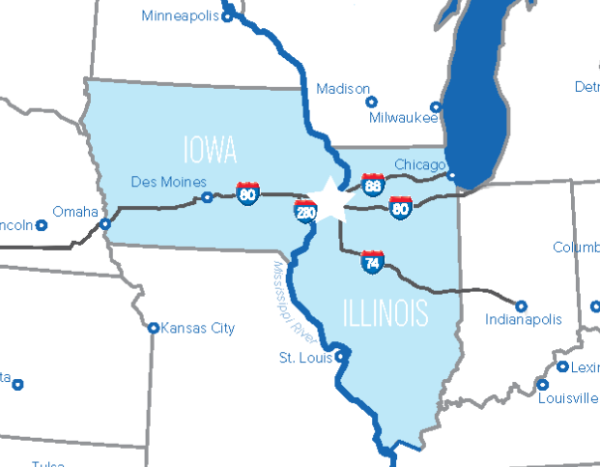
Map of the Quad Cities region
The heart of the Midwest
QC, That's Where? It's where two states and one mighty Mississippi River are home to a family of communities making the Midwest's future.