


Regional Market Summary Q2 2022

Strengthening local economy, stagnant national economy

Dr. Kenneth KrizWritten by Dr. Kenneth A. Kriz, Distinguished Professor of Public Administration, University of Illinois

The second quarter of 2022 saw economic growth once again below its long-term trend. The previous quarter had seen negative economic growth for mainly technical reasons, as explained in our Q1 2022 summary. In the second quarter, however, slightly negative economic growth continued, but the technical reasons for the decline faded. The weight of worldwide economic concerns such as renewed lockdowns in China and other Asian countries, and the ongoing war in Ukraine, along with fears of a hawkish Federal Reserve created a drag on economic activity.

Real economic growth at the national level (measured by Real Gross Domestic Product (GDP) was a negative 0.9% in the first quarter (Figure 1). The impressive economic growth of 2021 clearly seems to be passed. The economy has recovered from the worst of the COVID pandemic, but there is evidence that the longer-term effects of the economic disruptions may be more serious than previously thought. Business investment was one of the more negative components of Q2 GDP growth, causing concern about slower growth in the second half of 2022 and the first half of 2023. Looking forward, an average of “nowcasts” from various forecasters that we track indicates that real GDP growth will be around 1.2% in the third quarter of 2022, still below the trend growth rate of the decade prior to the COVID pandemic, but a clear improvement from the past two quarters.

Actual, trend and projected GDP growth

Figure 1. Source: U.S. Bureau of Economic Analysis (Actual), Federal Reserve Bank of Philadelphia (Pre-COVID Trend Growth), Federal Reserve Bank of Atlanta, Kluwer-Wolters Blue Chip Estimates, Moody’s Economy.com and author calculations.


Payroll employment was significantly stronger in the Quad Cities region in the second quarter

On a national level, the labor market continued its slow recovery (Figure 2). Payroll employment at the national level increased by 0.8% during the first quarter. This was the slowest rate of growth since mid-2021, also a worrying sign for economic growth. However, the Quad Cities region experienced very strong job growth in April and May, moderating slightly in June. Overall, the number of jobs in the region increased by 4.7% in the second quarter. This is the strongest quarterly rate of job growth since the start of the pandemic. Hopefully, this is the start of a trend toward stronger growth in job creation.

Figure 2. Source: U.S. Bureau of Labor Statistics. Note that the Quad Cities refers to the Davenport-Rock Island-Moline Metropolitan Statistical Area.


Job growth in various sectors

Examining the changes in job growth more closely, it appears that job growth in the Leisure & Hospitality sector accounts for a large portion of the overall Q2 job growth (Table 1). Jobs in that sector grew by over 11% from March to June. Manufacturing, Professional & Business Services, and Government were other sectors experiencing strong job growth in the second quarter. Other sectors lagged, however, and four sectors (Education & Health Services; Retail Trade; Trade, Transportation, & Utilities; and Wholesale Trade) saw job losses in the second quarter.

Table 1. Source: U.S. Bureau of Labor Statistics                                              


Quad Cities return-to-normal index continued to rise

Our “Return to Normal Index”, discussed in previous Quarterly Market Reports shows continued signs of strength in the regional economy. The Quad Cities economy picked up pace during the first half of 2022 (Figure 3). The index rose fairly steadily from January 1 to mid-March, then fell slightly at the end of April. But then the economy picked up again in May and June.

Figure 3. Source Data from Opportunity Insights and the U.S. Bureau of Labor Statistics. Calculations by author.


Core inflation rates have begun to fall

Going forward, the consensus of economic forecasters in the Survey of Professional Forecasters done by the Philadelphia Federal Reserve Bank is now that the economy will grow at a rate below long-run historical trends throughout 2022 and 2023. The “point estimate” of growth has been revised downward from 2.5% real GDP growth in 2022 from the Q2 report to 1.6% in the third quarter report. The variance of the estimates remains high, with significant numbers of professional forecasters seeing a risk of recession in 2022 or 2023. The consensus inflation estimate for 2022 was revised upward once again in the most recent report. The estimate is now 7.5% for the Headline Consumer Price Index and 4.5% for the less volatile Core Personal Consumption Expenditures Deflator.

As we have discussed in earlier summaries, one of the major long-term concerns for the economy is persistently high inflation, which may cause the Federal Reserve Bank to have to increase interest rates beyond what they might normally have to be in order to cool the economy and reduce price pressures. The third quarter held good news on this point. “Core” inflation rates (which remove food and energy price changes because of their volatility) fell from their highs in the first quarter. The Core Consumer Price Index, calculated by the US Bureau of Labor Statistics, had reached a high of nearly 6.5% in March. By June, it had fallen slightly below 6% (Figure 4). The Core Personal Consumption Expenditures Price Deflator, calculated by the US Bureau of Economic Analysis and the preferred measure of the Federal Reserve Board’s Monetary Policy Committee, fell from 5.3% in February to 4.8% in June. The combination of tighter monetary policy, along with falling energy prices (although not part of the indices the impacts of falling energy prices may carry over to goods and services through falling production and transport costs) and improvements in supply chain disruptions may result in lower core inflation without the need for the Fed to enact draconian rate increases in the second half of 2022.

Figure 4. Sources: U.S. Bureau of Economic Analysis (Core PCE Deflator), U.S. Bureau of Labor Statistics (Core Consumer Price Index).


Overall, the data indicates a somewhat stagnant national economy and an improving regional economy. As we see continued reopening of the economy, we expect to see continued improvement in services spending and employment. The bigger uncertainty for future economic growth involves the impact of potential Federal Reserve and US Federal Government policies on overall economic activity. If the Federal Reserve pursues an aggressive monetary policy to try to reduce inflation, or the Federal Government retrenches to reduce potentially unsustainable budget deficits, the policy changes are likely to produce strong downward pressure on economic activity. The implications for the Quad Cities region are difficult to forecast with precision, but certainly these policies will present a challenge for future economic growth.

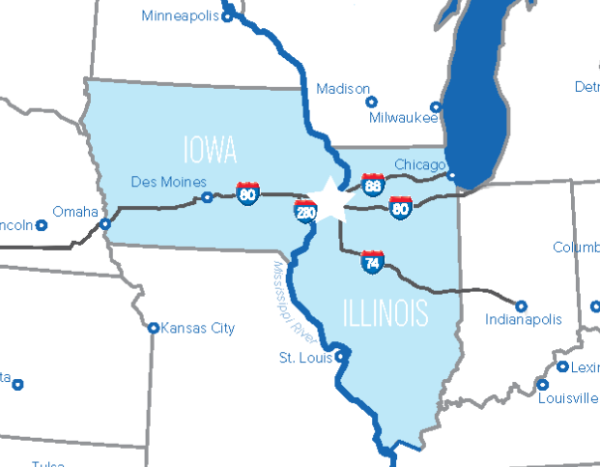
Map of the Quad Cities region
The heart of the Midwest
QC, That's Where? It's where two states and one mighty Mississippi River are home to a family of communities making the Midwest's future.