



Regional Market Summary Q4 2024

What comes after a "soft landing?": Growth outlook positive though risks remain; Midwest slightly lags behind national conditions

Written by Bill Polley, Ph.D., Director of Business Intelligence, Quad Cities Chamber

“The U.S. growth outlook shows us that we’ve experienced the best economy in a generation—that people still love to hate.” That is how RSM Deputy Chief Economist, Kevin Depew, described the U.S. economy at the Quad Cities Chamber’s annual Economic Forecast event in December. As we wrapped up 2024, that certainly was the case. Real GDP growth throughout the year was quite robust, coming in at 2.3% for the 4th quarter and 2.8% for the year. This was the third year in a row in which real GDP grew at a rate between 2 and 3%, and it took place in the wake of a dramatic increase in interest rates to slow inflation.

This is the economy that defied the odds, avoiding a recession even as rates stayed higher than initially expected. As we transition into 2025, it is safe to say that the “soft landing” that has been discussed for over a year has actually been achieved. We are now about 5 months from the first rate cut back in September, and now in a pause as the Federal Reserve held rates steady in January as the economy continues to roll along without the need for additional stimulus. The risk of a recession this year has not disappeared entirely, but the risk is more from an unexpected shock rather than from monetary policy error (holding interest rates too high for too long). With real GDP growth in the current quarter expected to once again come in at over 2% (as of the time of this writing in late February), that would be two quarters of growth at or above trend following the start of the rate cuts.

However, unlike a gymnast who "sticks the landing" or a golfer who lands the ball near the hole for an easy putt, there is no clearly defined ending when you have a "soft landing" in the economy. Time marches on, and the economy keeps moving. There's no time to sit around and congratulate yourself--you need to face the next challenge ahead.

That is a good description of where we are in the current economic environment. We had a pretty good run by avoiding a recession that some thought was inevitable starting back in the summer of 2022 when the Fed started raising rates. Inflation, though not fully conquered, is mostly under control. Job gains were impressive. New technologies improved productivity. We have proven that we can have solid growth even while interest rates rise. "The best economy in a generation," in Depew's words. Yet challenges lie ahead. The economic story of 2025 will be a new story more than it will be a continuation of the story begun after the COVID-19 recession. The big question right now is which way things might break. Is the soft landing a springboard to even faster growth? Or do these new challenges start to bog down an economy that is showing its vulnerability? Is it even possible to just coast along here at a nice, even pace? What comes after a soft landing?

GDP grows at 2.3% in 4th quarter

Source: U.S. Bureau of Economic Analysis. Gross Domestic Product (Advance estimate for most recent quarter).


The winter of our discontent

As Depew put it, there are aspects of this economy that some people “still love to hate.” Part of this can be chalked up to the fact that the labor market has slowed significantly since the robust growth in the initial recovery from the COVID-19 recession. The labor market was much more friendly to job-seekers in 2023 and early 2024 than it was a the end of 2024. While there has been an increase in layoffs in some industries, the larger trend nationwide in the labor market is a smaller number of job openings than a year ago.

Inflation is also a source of discontent. Despite the hopes in early 2024 that we might be on a glidepath toward the Federal Reserve’s target of 2% inflation, we never quite got there. On a 12-month basis, the Fed’s preferred inflation gauge, the Personal Consumption Expenditures (PCE) deflator, rose from 2.1% in September to over 2.5% in January. The Consumer Price Index (CPI), more familiar to many people, rose similarly from 2.4% to 3.0% in the same period. As we discussed in a recent Weekly Economic Trends and Indicators blog, the surge in inflation is due to more than just the price of eggs.

Because of these factors—a weaker labor market and rising inflation—the economy is more vulnerable to unexpected shocks than it would be were it not for these factors. Uncertainty about the new presidential administration’s economic policy may also contribute to some amount of unease—particularly concerning tariffs and layoffs within the federal workforce, two issues that have gained much attention lately. It is too early to tell just how much influence any of these policy decisions will have on the course of economic activity later in the year and beyond.

Source: Bureau of Labor Statistics


Regional conditions slightly lagging national conditions

As a result of many factors, including a slowing labor market, rising inflation, and little growth in manufacturing, the Midwest has seen more of a decline in activity than other parts of the country, particularly the West and some parts of the South. This can be measured in a variety of ways. The State Coincident Index from the Philadelphia Fed declined by 0.3% in Iowa from September to December. The index for Illinois rose by 0.5%. For comparison, the index rose by 0.6% for the U.S. as a whole.

Layoffs increased throughout the quarter in the Midwest rising to 406,000 in the month of December (seasonally adjusted) compared to 358,000 a year ago. The Midwest and Northeast had the highest rates of layoffs in the U.S. in December.

The Federal Reserve’s Beige Book, which reports on economic conditions in the 12 Federal Reserve districts across the country, noted the following about conditions in the Chicago district (where the Quad Cities is located): “Economic activity increased slightly. Consumer spending increased modestly; employment increased slightly; construction and real estate was flat; nonbusiness contacts saw little change in activity; and manufacturing and business spending decreased slightly. Prices increased modestly, wages rose moderately and financial conditions loosened some. Farm incomes in 2024 were below those of 2023.”

Finally, the Weekly State-Level Economic Conditions Index fell for both Iowa and Illinois during the quarter. Earlier in the year, the indexes for both Iowa and Illinois were higher than the overall index for the U.S. By the end of the year, all three were below zero, which indicates growth below the long-term average. (In the first few weeks of 2025, the index for the U.S. has almost returned to the long-term average, though more recent data for individual states is not yet available.)

Source: Baumeister, C., Leiva-Leon, D., and Sims, E. (2021). Tracking Weekly State-Level Economic Conditions. Unpublished paper. Notre Dame University, Banco de Espana, National Bureau of Economic Research, and Center for Economic and Policy Research.


Status quo--at least for now

Despite the vulnerabilities and sources of discontent, on balance, the growth outlook for the U.S. economy remains quite positive. Consumer spending remains strong, boosted by a surge in durable goods spending as a result of lower interest rates. Productivity continues to grow at a rate that helps keep inflation from rising too quickly and provides a good base for growth. Despite the recent rise in inflation and softer labor market, growth expectations are still basically status quo.

Our Business Outlook Survey also has a status quo flavor. More survey respondents noted increasing activity than decreasing activity during the last quarter, and that sentiment carries forward to their expectations for the next 6 months. They also note slight increases in hiring as well as continued upward pressure on wages and prices.

Still, there is not universal agreement about where we go from here. Opinions differ on whether the labor market has turned or is about to turn the corner and about how much we should worry about the recent uptick in inflation. In our survey, this showed up as about an equal number of respondents thinking the next 6 months will be better or worse than the last quarter.

Opinions also differ on the effects of policy on growth prospects. Will spending reductions and layoffs in the federal government have a ripple effect on consumption, or will that effect be too small to be noticed? Will tariffs have a positive effect on domestic industries or a negative effect on global supply chains? The answers are not easy.

So while status quo growth at about the long-term average rate is still a reasonable expectation for 2025, there is both a downside and an upside risk. The upside risk is that productivity growth boosts the job market while keeping inflation in check. The downside risk is associated with uncertainties surrounding tariff policy, taxes, government spending and other unknowns.


Conclusion

For the economy to have a truly stellar performance this year would require some help. Productivity growth would need to accelerate. Conditions around the world would need to improve. At the local level, farm incomes would need to rebound significantly. While these things are possible, they are less likely than the status quo.

By the same token, a significantly worse performance would require something that is not yet foreseen. A decline in consumer sentiment for whatever reason is one possibility since the economy has been so reliant on the consumer in this cycle. Changes in business sentiment regarding the prospects for AI could also be a catalyst for a downturn. Of course, ever present geopolitical risk and its effect on commodity prices could also change the forecast quickly.

In the end, with the information we currently have, continued moderate growth seems most likely until we better understand the new risks that have entered the picture in recent weeks.

Bill Polley
Contact
Bill Polley
Senior Director, Business Intelligence - Grow Quad Cities
Click to View Email
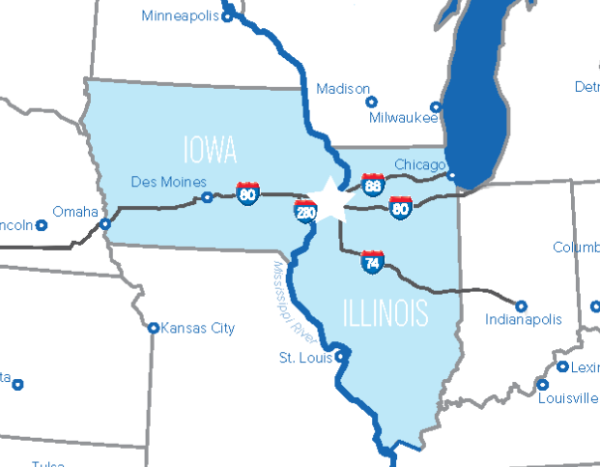
Map of the Quad Cities region
The heart of the Midwest
QC, That's Where? It's where two states and one mighty Mississippi River are home to a family of communities making the Midwest's future.