Business Outlook Survey Q4 2024

Survey respondents divided on U.S. economic performance; increased hiring expected

Last quarter

Looking back at the previous quarter, survey respondents were more divided on the performance of the U.S. economy with a nearly equal split between increasing, decreasing, and no change. This is quite different from the previous quarter where a larger share of respondents said that activity had decreased.

While they were split on the U.S. economy, their assessment of their own business was slightly better with a diffusion index of 11. Nearly a quarter of respondents increased their number of employees.

Respondents overwhelmingly reported increasing price pressures for their own goods and services as well as increasing wage pressures. At the same time, about half of the respondents reported increased capital expenditures in the quarter.

On balance, this is a slightly better picture than in the previous quarter.


Looking ahead

When asked about the next six months, respondents were still split on how they expect the U.S. economy to perform. There is a notable difference, however, in the share who answered "no change." This would indicate an expectation that something is going to change about economic performance, but that about equal numbers of people expected it to increase or decrease.

Expectations for their own company's economic activity are better than the previous quarter by a fairly large margin, and their number of employees are expected to continue to increase.

Wage and price pressures are still evident, and capital expenditures are expected to continue to increase.

We note that local businesses are seeing similar trends compared to what we hear about in the national data. Nationally, inflation expectations are increasing, especially in the last few weeks. Also, many national opinion polls show a significant divide in perceptions of the nation's economic performance.


Special focus

This quarter's special focus question was on the announcement of tariffs by the new presidential administration. The question was stated in the following way:

Recently, President Trump announced 25% tariffs on goods imported from Canada and Mexico as well as an additional 10% tariffs on goods imported from China. These have since been paused for one month. This week, the President announced 25% tariffs on imported steel and aluminum.

What do you expect the impact of the administration's tariff policy will be on your business?

What do you expect the impact of the administration's tariff policy will be on the U.S. economy?

The most frequent answers were "small negative" and "approximately zero."

Most economists would point out that tariffs, which are taxes on imported goods, cause inefficiencies which ultimately harm consumers. However, the price effects of tariffs can be positive for domestic producers--which is why many industries lobby for the protection afforded by tariffs. The gains and losses from tariffs are not evenly shared across the economy.

It has also been noted in the ongoing national discussion of tariff policy that tariffs can be used strategically to benefit the country by obtaining more favorable trade deals. While this is true, it is risky because of the potential for retaliation from other countries.

Our respondents, who come from a wide array of businesses in the Quad Cities area, reflect the diversity of opinions on this topic. Members of the business community understand these nuances and have differing views on the size of the various effects. However the assessment that the effects are more likely to be negative than positive, but the effects are likely to be small (possibly zero), is an assessment shared by many across the country.



About the survey

Beginning with the 2023 Q3 Quarterly Market Report, the Chamber began a survey of local businesses to gauge the state of the Quad Cities economy. This survey is similar to surveys conducted by groups around the country, in that it asks some basic questions about the respondent’s assessment of economic activity, wages, hiring, capital expenditures and a few other indicators. The options for each question are “increasing,” “decreasing” or “no change.” A “diffusion index” is calculated for each question, which is simply the difference in percentage points between “increasing” and “decreasing.” This diffusion index captures the degree to which respondents as a group feel that a certain aspect of the business climate is changing in one direction or the other.

The responses this quarter are a representative mix of companies from the region with 13% manufacturing, 27% retail, 38% service providers and 22% other. (In some lines of the tables, percentages may not total 100 due to rounding.)

This survey is a regular feature in the Quarterly Market Report, and we invite our members and other local businesses to watch for the survey invitation next quarter.

As the difference in responses between manufacturing and non-manufacturing companies was not significant, only the overall results will be reported this quarter.

Bill Polley
Contact
Bill Polley
Senior Director, Business Intelligence - Grow Quad Cities
Click to View Email
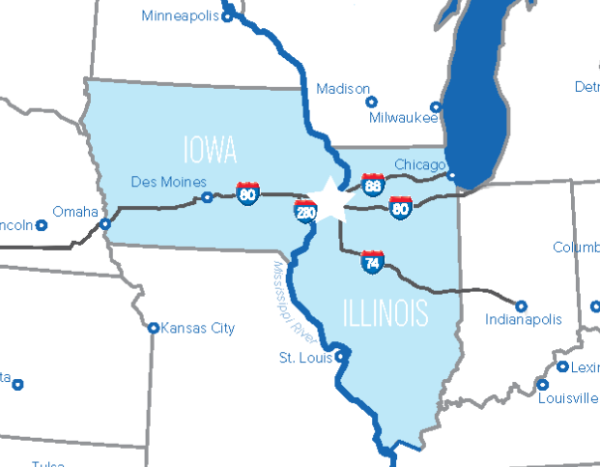
Map of the Quad Cities region
The heart of the Midwest
QC, That's Where? It's where two states and one mighty Mississippi River are home to a family of communities making the Midwest's future.