




Regional Market Summary Q2 2025

On the Rebound: U.S. Economy Bounces Back in Q2; Midwest economy sees little change

Written by Bill Polley, Ph.D., Senior Director of Business Intelligence, Grow Quad Cities/Quad Cities Chamber

After a lackluster first quarter that was marked by a dramatic increase in imports, the U.S. economy bounced back in the second quarter. To use a basketball analogy, the first quarter was like a shot that hit the rim. The tariff uncertainty that marked the first quarter created broader uncertainty that risked creating a broader slowdown. Consumption and government spending also stumbled on those concerns.

However, a basketball player does not stop when the ball hits the rim. Instead, that player springs into action, fights for the rebound, and puts up another shot. Likewise, the U.S. economy surged back with a 3.8 percent real GDP growth rate. As economic rebounds go, this was a strong one.

Even so, the bounce-back was not totally unexpected. Because the main source of the first quarter weakness was the “pull forward” of imports in advance of tariffs, most analysts predicted that there would be at least some recovery in the second quarter rather than a recession.

Will the momentum continue for the rest of the year? Plenty of uncertainty remains. In recent weeks, the balance of risks has shifted more to the labor market, even as inflation remains uncomfortably high. Tariffs are just now starting to have a real effect on the economy, and fiscal policy remains another source of uncertainty. Most analysts expect a positive third quarter, but after that, the forecast is more difficult.

Inflation-adjusted GDP up 3.8% in Q2

The story of second quarter GDP growth only makes sense in the context of the first quarter. The peculiarities of the first quarter essentially unwound in the second. This is best explained by referring to the contributions to the change in real GDP.

Imports were the main driver in both quarters. GDP measures spending on domestically produced output. Spending on imports shows up throughout the national income and product accounts: consumption, investment, and government. Therefore, imports need to be subtracted from GDP to remove spending that is not received domestically. In the first quarter (revised data) the increase in imports subtracted 4.70% from GDP growth. Yet in the second quarter, the pull back in imports once the tariffs took effect actually added 5.03% to the GDP growth rate. These two back-to-back quarters represent the largest contributions of imports to GDP (positive or negative) in recent memory. However, the net effect after the second quarter was only about a third of a percentage point.

Many of the imports that were pulled forward by the tariff expectations in the first quarter were stockpiled in business inventories. The increase in inventories added 2.58% to GDP growth in the first quarter. In the second quarter, as those imports were used in the manufacturing process or sold at retail, the fall in inventories subtracted 3.44% from GDP growth.

Meanwhile, other components of GDP changed much less dramatically. Total government (all levels combined) spending was essentially flat for the quarter with a 5.9% drop in federal spending balanced by a 3.1% increase at the state and local levels. Nonresidential and residential structures were down slightly, reflecting continued weakness in the housing sector—especially in markets that had seen large gains. Personal consumption expenditures were up 2.5%, accounting for only 1.68% of the 3.8% GDP growth rate. That was a better showing than the first quarter, but below the recent trend.

Real final sales to private domestic purchasers, a measure that excludes volatile components like inventories, exports, and government spending to focus on underlying demand, grew 2.9% from April through June, up from 1.9% in the first quarter and the government's previous estimate. This metric suggests the economy's core momentum remained healthy despite the oversized swings in imports and inventories.


Effect of tariffs on prices

Now that tariffs have been in effect for several months, we are starting to see some effect on the prices of goods. The main question has always been who would bear the burden of the tariffs: foreign producers, domestic importers, or domestic consumers. All three groups will bear the burden at different times. Foreign producers may feel the impact first as international competition causes them to accept lower prices. However, before too long domestic importers will feel their profit margins being squeezed. Given enough time for everything to sort itself out, we would expect the effect to filter through to the consumer. However, this could, in the case of some goods, take many months.

There has been considerable talk throughout the summer about the effect of tariffs on profits. However, new research suggests that we are already at the stage where the tariffs are being passed through to consumers, at least for some goods.

A survey by the New York Fed found that almost a third of manufacturers had completely passed the cost of the tariffs on to the consumer. Nearly 75% of all businesses had passed along at least some of the cost to consumers.

The Atlanta Fed survey found somewhat fewer firms would completely pass along the tariffs to the consumer. About 20% of firms surveyed expected to pass along 100% of the tariff to consumers if it caused only a 10% increase in price. Only 10% said they would pass along 100% of the tariff if it caused a 25% increase in price.

However, both surveys found that the vast majority of firms would pass along at least some of the tariff, with about half of firms passing along 50% or more of the tariff.

In a study of price data, the Yale Budget Lab estimates that as of June, about 70% of the tariffs on core goods (excluding food and energy) had already been passed through to consumers. For consumer durables, they calculated the pass-through to be anywhere from 60-80%.


Monetary policy implications

The fact that tariff-induced price increases have already started to show up in consumer prices has brought renewed focus to inflation concerns and the Federal Reserve's delicate balancing act between its dual mandates of price stability and maximum employment

The 12-month CPI inflation rate stood at 2.9 percent in August 2025, representing a substantial decline from the peak inflation of the post-pandemic period but still meaningfully above the Federal Reserve's 2 percent target. The 12-month Personal Consumption Expenditures (PCE) price index—the Fed's preferred measure of inflation—increased 2.7 percent from one year ago as of August, while core PCE, which excludes volatile food and energy prices, rose 2.9 percent. The monthly change in the PCE price index from July to August was 0.3 percent.

The Federal Reserve has explicitly acknowledged these difficult tradeoffs in its policy deliberations. In a recent speech, Chair Jerome Powell noted that "near-term risks to inflation are tilted to the upside and risks to employment to the downside—a challenging situation," adding that "two-sided risks mean that there is no risk-free path." The Fed must balance its dual mandate of stable prices and maximum employment even as inflation remains elevated and the labor market shows signs of weakening. Powell emphasized that the Fed would "carefully assess and manage the risk of higher and more persistent inflation" and ensure "that this one-time increase in prices does not become an ongoing inflation problem."


Midwest regional economy sees slight increase in activity

In contrast to the strong rebound in the national economy, both Illinois and Iowa, as well as much of the Midwest, experienced little to no economic growth in the quarter. The State Coincident Index from the Philadelphia Fed increased by 0.7% for Illinois from March to June. The index for Iowa decreased by 0.6% in the same period.

That being said, the labor market basically held its own during the quarter. The rate of job openings was about the national average in Illinois in June though slightly lower in Iowa. However, indications are that Iowa's numbers are improving for the third quarter. Additional details related to the local Quad Cities labor market are covered elsewhere in this Quarterly Market Report.

The Federal Reserve's Beige Book, which reports on economic conditions in the 12 Federal Reserve districts across the country, noted the following about conditions in the Chicago district (where the Quad Cities is located): "Economic activity in the Seventh District increased slightly over the reporting period, while contacts expected a slight decline in activity over the next year. Employment increased modestly; consumer spending, business spending, and construction and real estate activity were flat; manufacturing declined slightly; and nonbusiness contacts saw no change in activity. Prices rose moderately, wages rose modestly, and financial conditions loosened slightly. Prospects for 2025 farm income were unchanged."

The Weekly State-Level Economic Conditions Index was slightly negative and showed little change for both Illinois and Iowa during the quarter. This indicates that growth in both states was slightly below average. Both states were also below the U.S. index, which was near average for most of April and May. Data was not available for June at the time of publication.


Source: Christiane Baumeister & Danilo Leiva-León & Eric Sims, 2024. "Tracking Weekly State-Level Economic Conditions," The Review of Economics and Statistics, MIT Press, vol. 106(2), pages 483-504, March.


Conclusion

Overall, U.S. economic performance in the second quarter was reassuring. The economy was able to rebound nicely from the sudden large change in the tariff environment that impacted many businesses.

The Midwest, being disproportionately affected by events impacting agriculture and international trade, has struggled a little for the last two quarters compared to other parts of the country. Cyclicly low commodity prices and the exposure to tariffs are the primary headwinds. The tariff problems facing manufacturers will improve with their ability to pass along prices. Reversing commodity price trends may take longer.

The Fed, for its part, recognizes the somewhat precarious position in which the economy finds itself. The pass-through effect we have already experienced from the tariffs is positive in the sense that a significant share of the one-time inflationary impact has already happened. This gives the Fed some room to cut short-term interest rates going into the end of the year. The strength of the fundamentals of the economy have kept the U.S. out of recession this year even as growth has been uneven across regions and across sectors. The rebound will likely continue at least for the third quarter.

Bill Polley
Contact
Bill Polley
Senior Director, Business Intelligence - Grow Quad Cities
Click to View Email
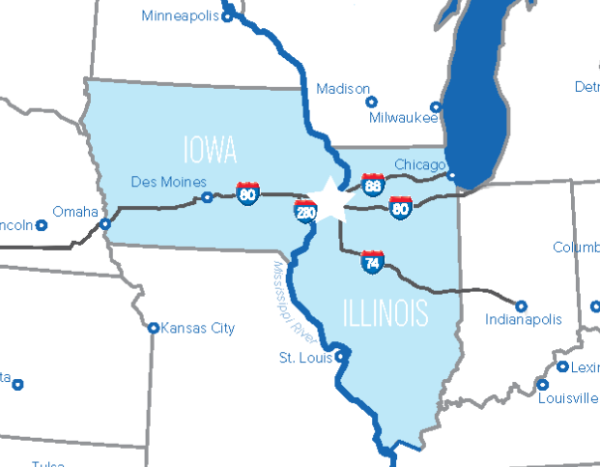
Map of the Quad Cities region
The heart of the Midwest
QC, That's Where? It's where two states and one mighty Mississippi River are home to a family of communities making the Midwest's future.