Regional Market Summary Q2 2023

"Soft Landing" or "Rolling Recession?"

Written by Bill Polley, Ph.D., Director of Business Intelligence, Quad Cities Chamber

Ever since inflation began to climb sharply in late 2021, a chorus of pundits opined that a recession would be impossible to avoid. Possibly, some even ventured, we would see a return to the “stagflation” of the 1970s when inflation continued unabated even as the economy stagnated. As another quarter goes into the books, we once again note that the worst of those fears are still unfounded. Second-quarter real GDP growth (second estimate) came in at 2.1 percent, and first-quarter growth was revised upward to 2.0 percent (see Figure 1). All things considered, that is acceptable, though it is somewhat lower than we would prefer.


REAL GDP GROWTH STILL POSITIVE, BUT BELOW TREND

Source: U.S. Bureau of Economic Analysis. Gross Domestic Product (Second Estimate).


SOFT LANDING?

How has the U.S. economy managed to avoid a recession in the face of over a year of the Federal Reserve’s interest rate increases? One possibility is that the Fed’s communication strategy has kept inflation expectations contained. The importance of this cannot be overstated. Enough market participants believe that the Fed is serious about bringing inflation down, even at the risk of slowing the economy. Few are willing to take the other side of that bet. As a result, inflation comes down without a recession—the elusive “soft landing.” Obviously, this did not happen in the 1970s. The Fed’s credibility was not what it is today, and it effectively had no communication strategy at all. Things are different now. Disco is out. Soft landings are in.


INTEREST RATES THEN AND NOW

What evidence do we have that such a scenario is even possible? The closest historical guide to our current situation is the mid-1990s. Figure 2 shows the increase in the effective federal funds rate in the two tightening cycles: 1993-98 and the current cycle beginning in 2022. In each case, the beginning point is the quarter before the policy tightening began. As we can see, the current series of rate increases compares quite well with the mid- ‘90s. At the time, inflation had begun to rise, though not nearly as sharply as in the current cycle, and the Fed did not want it to get out of control. Hence, the rate hike was sharp, and the communication strategy was bold. It was during this time that the Fed began to announce its moves with a press release—a move that would have been unthinkable in the ‘70s. This set the stage for the evolution of their communication strategy, which now includes press conferences by the Fed Chair.

Source: Federal Reserve Economic Database


REAL GDP IN THE '90s

Plenty of economists at the time expected a recession, but it never materialized. Figure 3 shows real GDP growth following the rate hikes. At the start of the rate increases, GDP growth was on the upswing, peaking about a year into the rate hikes (about where we are now in the current cycle). There was then a brief slowdown before a resumption of growth rates that kept rising above four percent and stayed there until 2000.

Source: U.S. Bureau of Economic Analysis


REAL GDP GROWTH NOW

The current situation is, admittedly, different. In 2021 we were coming off a dramatic post-pandemic rebound of the economy, so real GDP growth was already falling when the rate increases started. In fact, this is why the recession talk was so strong. Growth was falling, and the economy still looked vulnerable after such a severe shock. However, as Figure 4 shows, that slowdown did not last long, and at this point in the cycle, we are close to the kind of growth rates we saw back then--just above two percent and appearing to turn higher.

Source: U.S. Bureau of Economic Analysis


OPTIMISTIC OUTLOOK WITH A FEW CAVEATS

What is necessary to keep this going and keep us on a trajectory that looks like the '90s (Figure 3)? If we look at the ‘90s for guidance, we can point to a credible Federal Reserve, strong productivity and a strong labor market. In this cycle, we are mostly there. The Fed’s credibility has held up well. The labor market has performed well, though there have been a few bumps in the road. Productivity is also performing similarly to the mid- ‘90s, and this was right before a significant productivity increase that took us through the remainder of the decade.

Can it happen again? There is reason to be cautiously optimistic. The “GDPNow” forecasting model from the Federal Reserve Bank of Atlanta (as of the time of this writing), estimates a third-quarter real GDP growth rate of 4.9 percent. This would be remarkable if it turns out to be true. However, it should be cautioned that the estimate has been trending down in recent days. For comparison, they note that the Blue Chip forecast is now around three percent and rising (it was at zero percent in June). Even if they meet in the middle (around four percent), that would be welcome news.

Of course, as the Grateful Dead sang, “Every silver lining’s got a touch of grey.” There is a downside to robust growth at this point in the cycle. It would prompt the Fed to keep interest rates higher for longer. The danger of that is that sectors that are most sensitive to rate increases will struggle the most. Unfortunately for the Midwest region in general and the Quad Cities region in particular, this includes manufacturing. According to the most recent Federal Reserve “Beige Book” summary of economic conditions, “New orders were stable or declined in most Districts, and backlogs shortened as demand for manufactured goods waned.” Economic weakness in China could also prove to be a headwind for manufacturing.

For now though, other sectors of the economy are taking up the slack. The housing market, which had faltered briefly when rates rose so sharply, seems to have regained its footing. The consumer remains strong, though many note that the resumption of student loan payments in October will cut into consumer spending and increase debt and delinquencies.

The nascent field of artificial intelligence (AI) has the potential to add to productivity growth over the next decade, much like the Internet did in the ‘90s. As with the Internet, the productivity growth may not be as dramatic or as quickly realized as some envision, but like the Internet, it could revolutionize many business processes behind the scenes and lead to unexpected types of productivity enhancements. Recent advances in AI have spurred the semiconductor industry out of its slump and bode well for the future.

This uneven pattern of growth across different sectors has been labeled by some as a “rolling recession.” That is, a slowdown and recovery in activity that moves from one sector or region to another over time. Such a scenario helps the aggregate growth figure look good, but it conceals some of the churning that is happening beneath the surface. There is no agreed-upon definition of what precisely constitutes a “rolling recession.” The good news is that it would suggest that sector-specific or region-specific slowdowns will be short-lived.



IOWA AND ILLINOIS GROWING FASTER THAN US AVERAGE

We conclude by noting that the Quad Cities region is currently well-positioned to ride out the remaining uncertainty as we look for confirmation of a soft landing. Figure 5 shows the Weekly State-Level Economic Conditions index. On this chart, 0 represents the long run trend. By their calculations for the second quarter, Iowa is above trend, and Illinois is slightly below trend, but above the U.S. average. More recently, the U.S. average has started to turn upward. If that trend continues for the rest of the quarter, it would be indicative of third quarter real GDP of around 3 percent or more, similar to the GDPNow forecast and the Blue Chip forecast.

Source: Baumeister, C., Leiva-Leon, D., and Sims, E. (2021). Tracking Weekly State-Level Economic Conditions. Unpublished paper. Notre Dame University, Banco de Espana, National Bureau of Economic Research, and Center for Economic and Policy Research. Available at: https://sites.google.com/view/weeklystateindexes/dashboard

Bill Polley
Contact
Bill Polley
Senior Director, Business Intelligence - Grow Quad Cities
Click to View Email
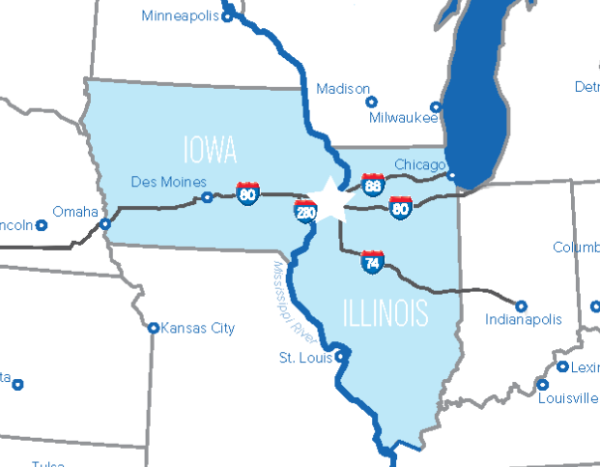
Map of the Quad Cities region
The heart of the Midwest
QC, That's Where? It's where two states and one mighty Mississippi River are home to a family of communities making the Midwest's future.