
Manufacturing orders are up, and sales are at record levels, but supply chain remains a challenge. Manufacturers are having to store inventory on-site while waiting on parts before they can ship products. Many lead times have gone from weeks to months to the better part of a year for many manufacturers.
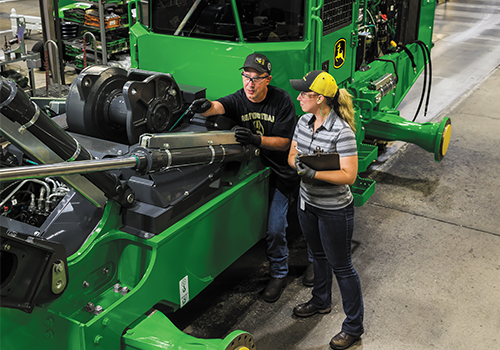
Some manufacturers are bringing production of components in-house, rather than waiting weeks or months for delivery. To get product to market quicker some manufacturers have started to fabricate their own parts. Some are even investing in innovative additive manufacturing technologies for plastic and metal component fabrication. This trend toward more vertically integrated manufacturing is increasing in the region.
The Chamber has met with local companies currently expanding their business into new markets. With increased focus on alternative energy, biosciences, plant-based materials and electric and autonomous vehicles, progressive companies are finding ways to expand their production capabilities into new markets that represent new high-growth industries.
A major manufacturer in the region recently shared that they are constantly investing in innovative technologies. In their words, they are always planning for an “evolution” not a “revolution.” By understanding trends in population and labor participation demographics, businesses know how important it is to incorporate technologies that can replace repetitive and labor-intensive processes and reallocate our human workforce talents to more specialized and technical work.
Workforce challenges persist and there is no single solution on the horizon. National site consultants recently shared with the Chamber that employee retention is the new workforce commodity, asking what companies are doing to retain current employees and what companies are doing to be an employer of choice.
Important metrics to study in understanding labor markets are population, migration, labor participation, unemployed, under-employed, workforce pipelines and special populations. It’s important to consider all factors in the analysis of local labor availability and determine if businesses are tapping into all the available labor populations.
For example, local data from the U.S. Census Report shows:
- Higher unemployment rates for people ages:
- 16-19
- 20-24
- 25-29
- 35-44
- These are all key working ages and yet they are all over 5% unemployment rates. This could represent opportunity for establishing more co-ops, apprenticeships for younger workers and flexibility for older workers.
- This holds true for the data on females with children. It’s important to note that mothers with one child are in the labor force at a higher percentage than those with multiple children. Cost of childcare is obviously an issue here, so how do companies adopt benefits that help defray the cost of childcare and support working parents, especially those with more than one child?
- The racial demographic information is significant. The glaring difference in the labor participation rate for each group may help human resource teams focus their outreach and employee affinity groups toward partnerships with local nonprofit organizations that support those citizens.
- Finding workforce solutions is not a short game. To win the war on talent, employers must take a closer look at the data and map out strategies that target available labor pools.