




Regional Market Summary Q1 2025

Winds of Change: Economy still on course despite a less predictable policy environment

Written by Bill Polley, Ph.D., Director of Business Intelligence, Quad Cities Chamber

In the days when sailing ships traversed the seas, mariners not only needed to know speed and direction of the wind at their current position, but also what the winds were expected to be later in their journey. The predictability of the wind was essential for reaching one’s destination. Winds that reliably blow in this way were known as “trade winds,” and although the etymology of the term did not originally have to do with international trade in goods, it soon became associated with the constant and predictable winds that made the shipment of goods across oceans, as from Europe to America, possible.

Of course, the wind is not always predictable. Storms appear out of nowhere and threaten to push ships off course. An isolated storm that happens once on a journey is usually not a problem. The captain can plot a correcting course to get back on track. However, if storms are frequent and unpredictable, the additional time and the risk of damage to the vessel could make the journey no longer worth the effort. It may be best to wait until the seas become more predictable again.

Predictability is important in economics as it allows buyers and sellers to form accurate expectations about the future. The level of tariffs and other trade barriers worldwide have been mostly predictable in the post-WWII era with a general trend of gradually lower trade barriers, especially among industrial countries. While exceptions existed for one reason or another, the overall picture was one of stability and predictability.

Recent trade policy announcements have upended the notion of predictability. Changes in tariff levels are no longer the product of lengthy multilateral negotiations, but are instead posted on social media and then modified or paused a few days later. This raises the question of whether there are negative consequences of a less predictable policy environment.

Inflation-adjusted GDP decreased 0.2% in 1st quarter

The fact that tariffs have become one of the most visible policy tools of the Trump administration should come as no surprise. President Trump campaigned on this issue and, as president-elect, promised tariffs specifically on China, Canada and Mexico prior to his inauguration. If anything, the delay in the announcement was the surprise, as he had promised that the tariffs would come on the first day of his term. Yet the delay in the implementation gave firms some time to import foreign goods prior to the tariffs being collected.

This leads us directly to one of the first effects of the tariffs to show up in the data. This effect appeared first because it was in play even before the tariffs were implemented. Real (i.e. inflation-adjusted) imports of goods jumped from $2.988 trillion (seasonally adjusted annual rate) in the fourth quarter of 2024 to $3.325 trillion in the first quarter of this year. This sudden increase was unlike anything seen in recent years, and it was based on the expectations of tariffs. In terms of our story, these are like the ship captains who set out early to get to the destination before the weather becomes unpredictable.

Overall, real gross domestic product (GDP) contracted 0.2% in the first quarter, the first decline in real GDP since the first quarter of 2022. Understanding the effect of imports on GDP requires a brief review of national income accounting. GDP is a measure of the value added in the economy based on production. One method of accounting for GDP involves adding consumption spending, investment in new capital by businesses, purchases of goods and services by all levels of government and net exports (exports minus imports). The reason that we use net exports (which means subtracting imports) is that imports are also counted in one of the other categories of spending (consumption, investment or government). Thus, for GDP to be a measure of domestic production, we must subtract the foreign goods which were counted in the other categories of spending.

Source: U.S. Bureau of Economic Analysis. Gross Domestic Product (Second estimate for most recent quarter).


Surge in imports pushed GDP lower

The increase in imports (both goods and services) contributed -5.2% to the GDP growth rate, offsetting the positive contributions from consumption (0.8%), gross private domestic investment (4.0%) and exports (0.3%). Government purchases also contributed negatively (-0.1%), mostly due to reductions in defense spending. Adding these contributions together (and subtracting the negative contributions) yields the -0.2% overall GDP growth rate.

The 4.0% contribution from investment was the highest since the fourth quarter of 2021 and is well above what we normally see. It turns out that more than half of that contribution was due to an increase in inventories (contributing 2.6%, also abnormally high). Hence, we can infer that a significant portion of the increased imports went directly into inventories and have not yet been sold. This would also include purchases of intermediate goods (auto parts, for example) that have not yet been used to produce the final goods.

This increase in imports in advance of the tariffs has been termed “pull forward” as it is literally pulling some of the imports that would have happened later into the current quarter. Once the tariffs go into effect, we would expect that imports would decrease from the elevated “pull forward” levels. The post-tariff import levels may be even lower than before the tariff announcement. The decrease may be temporary as firms use up their inventory or it may be permanent as the higher prices incentivize a shift to domestic goods.

According to April data, imports continue to be at an elevated level, so the current quarter will probably have some additional “pull forward.” This could mean that GDP will again be negatively affected this quarter. Whether GDP is able to rebound will depend on how long the pull forward effect lasts and on the nature of future tariff announcements.

Source: U.S. Bureau of Economic Analysis. Gross Domestic Product (Second estimate for most recent quarter).


Inflation on the decline, but expectations spike due to uncertainty

Inflation expectations have also been distorted by the uncertainty over tariffs even as the actual inflation rate has trended downward this quarter. The 12-month CPI inflation rate was back down to 2.4% in March after rising to 3.0% in January. The 12-month Personal Consumption Expenditures (PCE) price index (the Fed’s preferred measure of inflation) only rose as high as 2.7% in February, but was down to 2.3% in March. The month-to-month change in the PCE price index from February to March was essentially zero.

While the inflation rate has still not returned to the Fed’s goal of 2%, there was enough progress to resume the discussions of interest rate cuts. However, the uncertainty of tariffs interrupted that discussion. The concern is that because the tariffs are very wide in scope, there could be widespread price increases leading to inflation.

In the minutes of the Fed's May meeting, we find that the relationship between policy uncertainty and inflation was discussed: "Participants noted that the Committee might face difficult tradeoffs if inflation proves to be more persistent while the outlooks for growth and employment weaken. Participants observed, however, that the ultimate extent of changes to government policy and their effects on the economy was highly uncertain. A few participants additionally noted that higher uncertainty could restrain business and consumer demand and that inflationary pressures could be damped if downside risks to economic activity or the labor market materialized."

While the amount of inflation the announced tariffs would add is unknown, experience would suggest that it would be a measurable amount, though probably not as dramatic as the post-COVID-19 inflation now seared into our memory.

In fact, our recent experience with inflation may be partly responsible for causing consumers to be more concerned about the potential for tariff-induced inflation. The University of Michigan Survey of Consumers has found that one-year and five-year expectations of inflation have spiked from 2.8% and 3.0%, respectively, in December to 7.3% and 4.6%, respectively, in May. These one-year expectations are higher than they were even during the post-COVID-19 inflation and the highest in decades.

While tariff concerns may explain some of the spike in inflation expectations, consumers may also be reacting to fiscal policy and concerns about the deficit and the national debt which have pushed long-term bond yields higher.

Are these increased inflation expectations a concern? While the University of Michigan survey shows consumers inflation expectations rising, most professional forecasters’ one-year inflation expectations remain between 2 and 3% (as of March). Consumer expectations right now are being influenced by our recent history with inflation as well as the fact that prices are still perceived as high, particularly for some goods. Even though the tariffs are not likely to ignite a substantial amount of inflation, the hypersensitivity of consumers right now could lead them to overreact to any changes they observe, leading to excessive volatility in consumer spending.


Midwest regional economy mostly flat while labor market improves slightly

Both Illinois and Iowa, as well as most of the Midwest, experienced little to no economic growth in the quarter, mirroring the near zero GDP growth at the national level. The State Coincident Index from the Philadelphia Fed increased by 0.7% for Illinois from January to March. The index for Iowa increased by less than 0.1% in the same period. For comparison, the index for the U.S. increased by 0.6%

Layoffs and discharges decreased in the Midwest from a revised 391,000 in December (seasonally adjusted) to 325,000 in March. This is down from 380,000 last March. Additional details related to the local Quad Cities labor market are covered elsewhere in this Quarterly Market Report.

The Federal Reserve's Beige Book, which reports on economic conditions in the 12 Federal Reserve districts across the country, noted the following about conditions in the Chicago district (where the Quad Cities is located): "Economic activity was little changed. Consumer spending increased modestly; employment and construction and real estate activity were up slightly; manufacturing was flat; business spending declined slightly; and nonbusiness contacts saw a slight decline in activity. Prices increased modestly, wages rose slightly and financial conditions tightened. Prospects for 2025 farm income were unchanged."

The Weekly State-Level Economic Conditions Index was slightly negative and showed little change for both Illinois and Iowa during the quarter. This indicates that growth in both states was slightly below average. Both states were also below the U.S. index, which was near average for most of the quarter.

Source: Baumeister, C., Leiva-Leon, D., and Sims, E. (2021). Tracking Weekly State-Level Economic Conditions. Unpublished paper. Notre Dame University, Banco de Espana, National Bureau of Economic Research, and Center for Economic and Policy Research.


Conclusion

Given the increased uncertainty in recent weeks, it is notable that economic activity has not decreased more than it has. If this had happened when the economy was in a weaker state, the results could be considerably worse. Despite the negative GDP growth, which has a clear explanation, the fundamentals of the U.S. economy remain quite strong. This strength is evident in other measures of economic activity noted in the previous section which do not factor trade as heavily.

However, even strong economies can stumble if too much pressure is placed on them. In this case, the greatest risk is coming from policy uncertainty, especially with regard to tariffs.

The U.S. economy stands a good chance of rebounding from one negative growth quarter if consumer and business spending remain strong. The combination of "pull forward" from the anticipated tariffs and the potential reduction in spending once tariffs are fully in effect could disrupt spending patterns enough to slow growth. Consumer spending's contribution to GDP was an anemic 0.8% in the first quarter. Prospects for a rebound in the second and third quarters are greatly dependent on consumer spending, especially if business spending falters due to inflation and tariff uncertainty. Our Business Outlook Survey shows that local business leaders include inflation and tariffs among the issues that are the most pressing concerns.

As this Quarterly Market Report was set for release on May 29, the latest update on the tariffs was that the U.S. Court of International Trade has blocked the so-called "reciprocal tariffs" imposed in April but now mostly paused pending further negotiations. The court also blocked tariffs on Canada, Mexico and China that were imposed because of illegal drugs "because they do not deal with the threats set forth in those orders." Note that this ruling is not the final word as it will be appealed and it leaves open the possibility that the administration could use other justifications for higher tariffs. In the end, this ruling does little to solve the predictability problem.

Even if tariffs end up increasing by a modest amount, the economy could stay on track as long as there is predictability and stability in tariff policy. Unpredictable tariff policy will eventually wear on both consumers and businesses enough to cause a pull back in spending, like ships waiting out a storm. A return to stability could still prevent that outcome, but time is of the essence. Once unstable expectations actually begin to affect consumption in a visible and meaningful way, the probability of a prolonged slowdown, even a recession, increases.

Bill Polley
Contact
Bill Polley
Senior Director, Business Intelligence - Grow Quad Cities
Click to View Email
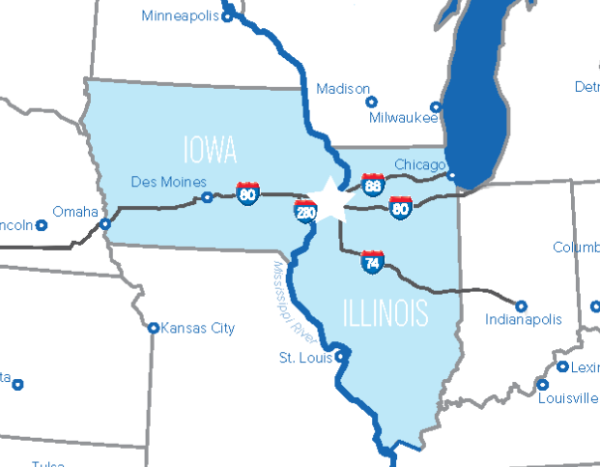
Map of the Quad Cities region
The heart of the Midwest
QC, That's Where? It's where two states and one mighty Mississippi River are home to a family of communities making the Midwest's future.