




Regional Market Summary Q1 2024

Cresting the hill: Local economic activity mixed as national economic growth dips below trend

Written by Bill Polley, Ph.D., Director of Business Intelligence, Quad Cities Chamber

If you have ever ridden a bicycle up and down hills, you probably are familiar with the feeling of briefly coasting as you top the crest of a hill before you face whatever is next--either another hill to climb or possibly a longer downhill run. Now imagine what it would be like if you had limited visibility ahead. This is a nice analogy to the current economic conditions, both nationally and regionally.

Real gross domestic product increased at a seasonally adjusted annual rate of 1.6% in the first quarter, down from a revised 3.4% increase in the fourth quarter of 2023. In our last Quarterly Market Report (late February), I wrote that real GDP growth was likely to decrease to below 3% and possibly below 2% in either the first or second quarter, so this was not unexpected. However, the actual number was somewhat lower than predicted by the Federal Reserve Bank of Atlanta's GDPNow forecast and the Blue Chip consensus from the same time period.

Most of the increase came from consumer spending. On the plus side, this is a sign of the resiliency of the consumer in this time of high interest rates. However, it is possible that record stock market levels have produced a "wealth effect" that has propped up the consumer. An economy that is too reliant on consumer spending could decline faster if something were to occur that would suddenly erode consumer confidence.

At the time of this writing (late May), the Atlanta Fed's GDPNow forecast stands at 3.5% real GDP growth for the second quarter with the Blue Chip consensus ranging from just over 1% to just under 3%. I believe the Blue Chip consensus probably has the correct range. A good case could be made for 2 to 3% which would be closer to the long-run trend growth rate. Such a growth rate would, in my estimation, be the "soft landing" that we have been expecting for the last couple of years.

Anything over 2.5%, however, could give cover to the inflation hawks who want to keep rates higher for longer. Currently, the market is expecting a rate cut in September, but above average growth could push that out farther. We have already seen expectations pushed back several months this year, and it is starting to take a toll on economic activity.

Nationally, the labor market continues to perform well, although the local labor market began to see some job losses in the quarter. This is discussed in more detail elsewhere in this Quarterly Market Report.

First quarter GDP slows

Source: U.S. Bureau of Economic Analysis. Gross Domestic Product (First Estimate).


Progress on inflation stalls in first quarter

The Federal Reserve's preferred indicator of inflation, the Personal Consumption Expenditures (PCE) price index, crept back up again in March. While it may not seem like much, it does highlight the fact that the it is proving difficult to wring the last bits of inflation out of the economy. The PCE price index generally stayed below 2% since 2012 until skyrocketing with the COVID-19 stimulus. The Fed has committed itself to get it back to that 2% goal. 2.7% is good, but not good enough.

It is actually somewhat remarkable that economic growth has been this robust while inflation has retreated so quickly. Two years ago, this was not expected to happen this way. However, the economy has benefitted from good productivity growth during that time that has allowed growth to continue even as inflation falls.

Long term prospects for sustained growth at low rates of inflation are quite positive because of expected productivity growth from innovations such as artificial intelligence (AI). It is expected that AI will provide opportunities for productivity growth similar to what we saw in the '90s from the Internet.

This may not always be the case in the short term. A temporary slowdown in productivity growth could increase the risk of either a recession or a resurgence of inflation. Inflation expectations could change to reflect the short term changes in productivity growth.

The New York Fed's Survey of Consumer Expectations measure of one-year ahead inflation expectations remained stable in the first quarter at 3.0%. However, at the time of this writing, April's numbers are available, and they did show an increase to 3.3% nationwide. Inflation expectations in the Midwest remained at 3.0%.

Overall, this is not bad news, though it may seem like it simply because we became accustomed to better than expected news on the inflation front in 2023. In my blog, I discuss additional reasons why inflation is likely to continue to retreat, albeit slowly, over the next year.


Flat growth in manufacturing; slight increase in other sectors

In our last Quarterly Market Report, I noted that manufacturing, which is heavily represented in the Quad Cities, began to slow down already in the fourth quarter. Not much as changed since then. The Federal Reserve "Beige Book" summary of economic conditions noted that the Chicago district (where we are located) experienced a slight increase toward the end of the quarter and that "contacts generally expected a similar rate of increase over the next year." However, manufacturing, construction and real estate activity were flat. Notably, they also mentioned that farm income was expected to be lower in 2024 compared to last year.

Once again, the Beige Book lines up very closely with the Chamber's own Business Outlook Survey in this Quarterly Market Report. One notable departure is that local survey respondents are slightly more pessimistic about the national economy than they are about the local economy. This is probably a reaction to the news of higher inflation and lower growth during the quarter. As we move forward, national numbers are expected to improve, which may help with perceptions.

There was some divergence in the Weekly State-Level Economic Conditions Index between Iowa and Illinois. Iowa's index remained above average and solidly in the top-half of states while Illinois remained closer to the overall U.S. performance during the quarter.

Source: Baumeister, C., Leiva-Leon, D., and Sims, E. (2021). Tracking Weekly State-Level Economic Conditions. Unpublished paper. Notre Dame University, Banco de Espana, National Bureau of Economic Research, and Center for Economic and Policy Research.


Conclusion

While it was a below average quarter for U.S. economic growth, there are still plenty of bright spots as we look ahead. Like the bicyclist that crests a hill and coasts briefly before attacking the next hill, the economy also occasionally takes a quick respite before resuming normal growth. It is not at all unusual for there to be a single quarter of lower growth in a series of above average quarters.

That being said, expectations are definitely less optimistic than few months ago. We see this both in our own regional survey and in data such as the New York Fed's inflation expectations. Historically, we have seen it go either way from this kind of a turning point. We hit a soft landing in 1995, but not in 2001. There are similarities and differences with regard to both cases, but in these situations, it is the unexpected (geopolitical issues, oil prices, sudden productivity shocks) that can pose the most significant threat. If we can avoid those unexpected shocks, and if the interest rate cuts can begin as early as September as we currently expect, the prospects remain quite positive for that soft landing--a brief time to coast before climbing the next hill.

Bill Polley
Contact
Bill Polley
Senior Director, Business Intelligence - Grow Quad Cities
Click to View Email
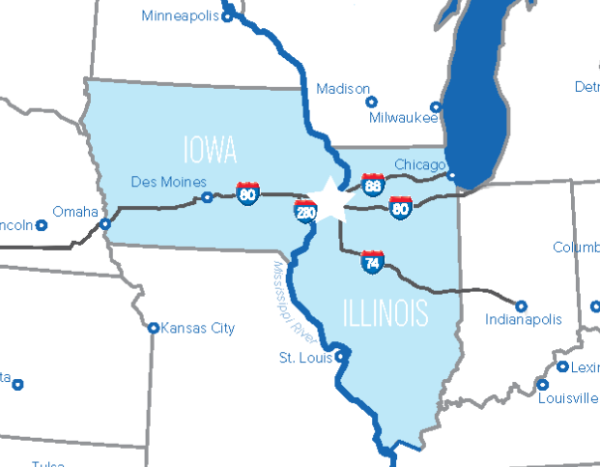
Map of the Quad Cities region
The heart of the Midwest
QC, That's Where? It's where two states and one mighty Mississippi River are home to a family of communities making the Midwest's future.