


Regional Market Summary Q3 2021

Confusing signals

Dr. Kenneth KrizWritten by Dr. Kenneth A. Kriz, Distinguished Professor of Public Administration, University of Illinois

During the third quarter of 2021, the national economic recovery from the COVID-19 pandemic and associated mitigation measures continued. However, pressures that emerged earlier in the year combined to slow economic growth. Despite this, there was evidence of a rebound on the horizon. The Quad Cities regional economy in many ways continued to lack momentum, continuing the effect we first saw early in 2021.

On the national level, the advance estimate for third quarter Real Gross Domestic Product (GDP) growth released in late October came in at a relatively slow 2.0%. We say relatively slow because GDP growth in the first half of the year averaged 6.5% per quarter. The “output gap” – the difference between Real GDP in Q2 2021 and where it was forecast to be prior to COVID – stayed at around $500 billion. However, there are signs that the fourth quarter will see resumed strong growth. An average of “nowcasts” from various forecasters that we track indicates that real GDP growth will be 6.4% in Q4. If the national economy grows that strongly at the end of 2021 and then continues the same pace that it has in 2021, the output gap will be closed by the middle of next year.  

The national economic recovery leveled off in Q3 2021

Source: U.S. Bureau of Economic Analysis (Actual), U.S. Federal Reserve Bank of Philadelphia (Survey of Professional Forecasters).


Inflation measures other than the official measure indicate much lower rates of inflation

Still, there are many uncertainties regarding the path of the economic expansion. Concerns about disruptions caused by the continuing pandemic have continued to weigh heavily on forecasts. There is some evidence that supply chain issues might be easing and the labor market appears to be improving, but concerns about inflation remain.

In terms of supply chain issues, recent data on the Baltic Dry Index indicate that shipping costs are finally falling after reaching record levels earlier this year. This is good news for input costs, indicating that the cost of production may soon be leveling off. However, data from the Global Purchasing Managers Index indicate that shipping times are still high, pointing to delays in deliveries of intermediate goods for production.

Inflation remains a concern. The Consumer Price Index (CPI) released by the U.S. Bureau of Labor Statistics increased by 5.38% year-over-year in September, while producer prices (PPI) were up an average of 8.6% over the same period. However, as with many of the economic releases there is some uncertainty over how much these figures were reflective of real price increases and how much were due to “base effects” caused by comparisons to depressed price levels in 2020. As we pointed out in the last QMR summary, many Federal Reserve Banks and other government agencies produce estimates of consumer prices that are less likely to be influenced by outliers and comparisons to previous years. These measures tend to show that inflation, while elevated from pre-COVID levels, is nowhere near as serious as the “headline” numbers suggest (Table 1).


Payroll growth has been steady both nationally and in the region

The labor market shows signs of a slow return to normal. While the Labor Force Participation Rate remains relatively low, as discussed in our last report, there is evidence that the economy is producing a significant number of jobs. Nationally, 18 million of the 20 million jobs (90%) that were lost in April 2020 have since been recovered. In the Quad Cities MSA, the figures are 18,000 of 24,000 jobs recovered (66.7% - Figure 2). The relatively slower recovery in the MSA labor market is likely due to the mix of industries in the area. Manufacturing employment nationwide has recovered more slowly than other sectors.

Source: U.S. Bureau of Labor Statistics


Unemployment rates generally fell during Q3 2021

Unemployment rates also improved in the third quarter. They moved down in the U.S., and in both Illinois and the Quad Cities MSA. However, the drop was largest in the MSA (Figure 3). The Quad Cities unemployment rate is almost back to the March 2020 level. This is another indication that the labor market is healing, albeit slowly.

Source: U.S. Bureau of Labor Statistics. Note that the Quad Cities refers to the Davenport-Rock Island-Moline Metropolitan Statistical Area.


Quad Cities return-to-normal index shows a slow recovery in the third quarter of 2021

The slow recovery continues to be evident in our “Return to Normal Index”. The index shows how regional economies are recovering from the COVID-induced recession using "high frequency" time series of economic activity (during the third quarter we were no longer able to obtain high frequency data on small business revenue and opening so we substituted payroll employment into the index calculations). The index suggests that since May there was a slight uptrend but not a strong recovery (Figure 4). We do note that the most recent iteration of the index shows that the regional economy has recovered almost to the pre-COVID level.

Source Data from Opportunity Insights. Calculations by author.


As we move into winter, the uncertainty that we first discussed in the second quarter remains in place and may be even more pronounced. The consensus of economic forecasters in the Survey of Professional Forecasters is that the economy will grow at rates faster than historical trends throughout 2022. However, as we saw in the second quarter, there is tremendous variability among the forecasters surveyed.  The uncertainty is even more pronounced with respect to the path of inflation. The consensus estimate for inflation shows relatively high inflation in the fourth quarter of 2021, with rates of inflation returning toward historical norms during 2022. But the variation in individual forecasts ranges from rates twice the historical average to rates near zero. The ultimate path of economic growth continues to rely on coronavirus infection rates and whether supply chain and labor force pressures abate.

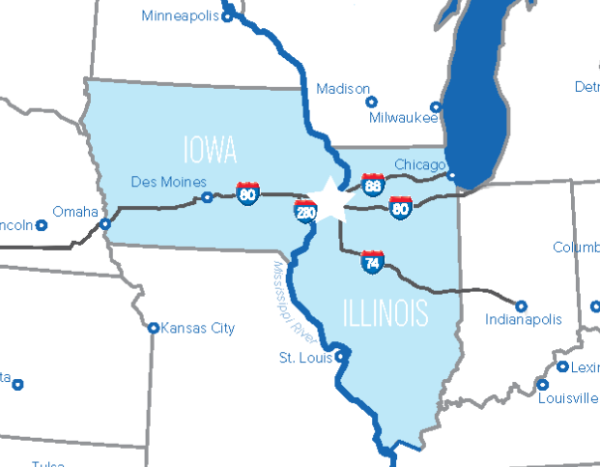
Map of the Quad Cities region
The heart of the Midwest
QC, That's Where? It's where two states and one mighty Mississippi River are home to a family of communities making the Midwest's future.