Regional Market Summary Q4 2020

Recovery: Fast, then Slow

Written by Dr. Kenneth A. Kriz, Distinguished Professor of Public Administration, University of Illinois

Recovery continued for the US and for the Quad Cities region in the fourth quarter of 2020. The recovery was strong during the early part of the quarter, then waned a bit as COVID cases mounted during the late fall and early winter. On the national level, after the robust 33% annualized rate of growth in national GDP during Q3, Q4 saw growth rates fall to a more normal but slightly elevated level of 4% (Figure 1). The “output gap” – the difference between real GDP in Q4 2020 and where it was forecast to be prior to COVID – is now $840 billion, compared to the $2.1 trillion gap in Q2 2020.


Fourth quarter 2020 shows continued recovery but at a slower pace


Recovery across industries is uneven, and growth slowed in Q4

As was discussed in earlier reports, the economic contraction in the second quarter of 2020 hit all major industries, with the recreation services being particularly hard hit (sectors such as the arts, recreation, accommodation, and food services). Transportation services and durable goods manufacturing other than autos and recreational vehicles were also hard hit. These are key sectors for the Quad Cities region. During the early recovery, the gains were similarly broad-based, with the sectors experiencing the deepest Q2 losses experiencing the largest Q3 increases. During Q4 industry fortunes started to diverge. Manufacturing continued to recover, albeit at a slower pace. But service growth became flat and some service sectors actually experienced a decline in activity in the fourth quarter due to the resurgence of COVID cases (Figure 2).


Unemployment rates rise dramatically, then fall in the nation and regionally

The recovery in the labor market continued in the fourth quarter, with national and regional unemployment rate declines (Figure 3). Unemployment had reached 14.8% nationally during the economic trough in April. By December, that rate had been cut more than half. In the Quad Cities metropolitan area, unemployment had risen substantially faster than in the nation as a whole, to a figure of 16% in April. However, it has fallen faster also, to a rate of 5.3% in December, within 1.5% of where it stood in March 2020. Revised estimates show that the metro area lost 17,400 nonfarm payroll jobs in April (9.5% of employment prior to COVID), recovering about one-half of those jobs by June. Job growth stagnated during the third quarter and fourth quarters in the metropolitan area, growing by less than 2% from June to December.


Quad Cities return to normal index shows a drop in November, then recovery in early December and another drop in late December

The stable recovery in early fall followed by contraction in the Thanksgiving to Christmas period is shown in our high frequency data. As described in earlier Quarterly Market Report summaries, we calculate an index for regions showing how well their economies are recovering from the COVID-induced recession using "high frequency" time series of economic activity (high frequency means that the data is available more frequently than traditional economic indicators released monthly, quarterly, or semi-annually). We present this for the Quad Cities metropolitan statistical area (MSA – Figure 4)

The index suggests that at the start of the fourth quarter the Quad Cities region was in the middle of a prolonged and slow recovery from the depths of the March-April plunge in economic activity. The federal stimulus in May started a strong recovery, but by summer the pace of recovery had slowed. Throughout late summer and early fall, the economy continued to recover. But by November, as case counts started to rise, people reacted defensively. In October, one of the components of the index, credit card spending, was at a pace near what it had been in October of 2019, prior to the pandemic. But then in the weeks between Thanksgiving and Christmas it fell below 2019 levels. Nearly all of the data that we use to create the index showed slowing during that time period.

As the economy moves into 2021, what is developing is somewhat of a race between the COVID vaccines and the new COVID variants. The arrival of vaccines was supposed to herald a quicker return to “normal” life and a quick recovery back toward long-term GDP and jobs growth. However, the emergence of new COVID variants with increased transmissibility and potentially greater morbidity has introduced a significant level of economic uncertainty.  The Philadelphia Federal Reserve Bank’s Survey of Professional Forecasters, released on February 12, contains data that reflects that uncertainty in economic forecasts. While the mean real GDP growth rate estimates for calendar year 2021 were revised upward from previous surveys (to 5.0%), the range of estimates is almost as wide as it was in the third quarter of 2020 when we were just emerging from the first wave of the virus. This is significantly above the usual range, reflecting significant uncertainties as we move forward. This uncertainty is a negative sign for future economic growth, as businesses will likely be loathe to hire or purchase as much equipment until the uncertainty is resolved.


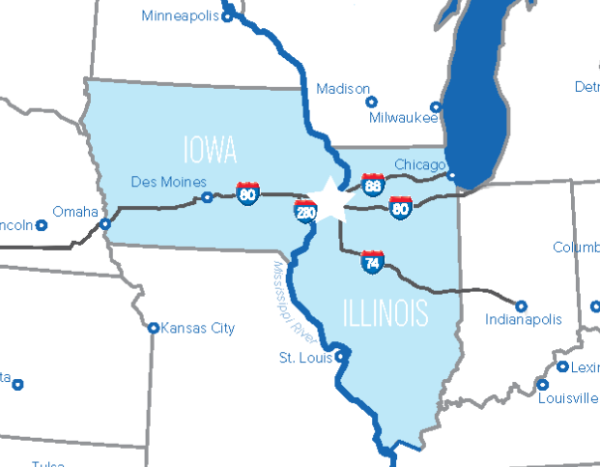
Map of the Quad Cities region
The heart of the Midwest
QC, That's Where? It's where two states and one mighty Mississippi River are home to a family of communities making the Midwest's future.