Regional Market Summary Q3 2022

Possibly a Return to Trend?

Dr. Kenneth KrizWritten by Dr. Kenneth A. Kriz, Distinguished Professor of Public Administration, University of Illinois

The third quarter of 2022 saw economic growth rebound from its sluggish pace in the first half of the year. Real economic growth at the national level (measured by Real Gross Domestic Product, or GDP) was 2.6% in the first quarter (Figure 1). Though below the robust growth during the 2021 COVID recovery, this pace is slightly above the long-term trend growth of the pre-COVID era. There is also some evidence that this growth at trend rates may be continuing into the near future. Looking forward, an average of “nowcasts” from various forecasters that we track suggests that real GDP growth will be around 2.4% in Q4.


Actual, trend and projected national GDP growth Q3 2022

Figure 1. Source: U.S. Bureau of Economic Analysis (Actual), Federal Reserve Bank of Philadelphia (Pre-COVID Trend Growth), Federal Reserve Bank of Atlanta, Kluwer-Wolters Blue Chip Estimates, Moody’s Economy.com, and author calculations.


Payroll employment grew more slowly in the Quad Cities region in the third quarter

On a national level, the labor market continued to grow at steady rates (Figure 2). Payroll employment at the national level increased by 0.75% during the first quarter. In the Quad Cities region, job growth slowed somewhat from Q3. Jobs in the Quad Cities region increased by 0.22% during Q3, down from over 2% in Q2. While the job market is still strong in the region, there is some evidence of softening. Another piece of evidence of this is that Average Weekly Earnings in the Quad Cities Region only increased by 0.8% from March to September. In the face of relatively high consumer inflation, wage growth in the region is not keeping pace with the cost of living.  

Figure 2. Source: U.S. Bureau of Labor Statistics. Note that the Quad Cities refers to the Davenport-Rock Island-Moline Metropolitan Statistical Area.


Quad Cities Return-to-Normal Index fell then rose again during Q3 2022

Our “Return to Normal Index” discussed in previous Quarterly Market Reports showed mixed signals in the third quarter. The Quad Cities economy fell off its pace from the first half of the year during July (Figure 3), but then the economy picked up again in August and the increased level of economic activity continued through September.

Figure 3. Source Data from Opportunity Insights and the U.S. Bureau of Labor Statistics. Calculations by author.


Real-time indicators are trending toward long-term trend growth

One of the things that some economists have noted about the state of the economy nationally is that while there was a period of below-trend growth in Q1 and Q2, and there have been many concerns raised about future economic growth effects from high inflation rates and the resulting policy shift toward greater monetary tightening by the Federal Reserve, the underlying state of the economy seems about average compared to long-term trends. Growth has definitely slowed since the torrid pace of 2021, but it has slowed toward long-term growth averages. Figure 4 demonstrates this for a frequently cited “high frequency” index, the Weekly Economic Index (WEI) from the New York Federal Reserve Bank. Calculated using high-frequency data sources using a methodology similar to our Return to Normal Index, the WEI provides a near real-time look at the state of the economy. Looking at the index, one can easily see the pandemic-related fall in economic growth and the extremely fast recovery during early-to-mid 2021. While growth has slowed since then it has taken us toward the pre-COVID average growth rate (the orange line). The most recent value of the WEI was 2.1%, just slightly below the 2010-2019 average growth rate of 2.13%. Other high-frequency indicators such as the Aruoba-Diebold-Scotti Business Conditions Index released by the Philadelphia Federal Reserve Bank and the Chicago Federal Reserve National Activity Index suggest much the same conclusion – that long-term economic growth has only returned to trend from the disruption caused by the pandemic and rapid recovery. Time will tell whether economic growth rates stabilize at long-term averages or continue to fall.

Figure 4. Source: Lewis, Daniel J., Mertens, Karel, and Stock, James H., Weekly Economic Index, https://www.newyorkfed.org/research/policy/weekly-economic-index.


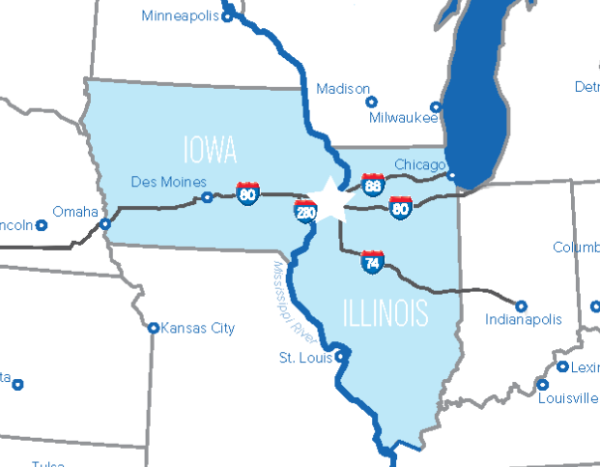
Map of the Quad Cities region
The heart of the Midwest
QC, That's Where? It's where two states and one mighty Mississippi River are home to a family of communities making the Midwest's future.