




Weekly Economic Trends and Indicators
Wall Street saw another record last week as the S&P 500 hit a new high last Thursday. Although the markets stumbled briefly on Monday due to concerns about AI in light of China's new "Deepseek" open-source AI product, by Tuesday morning the major indexes had recovered some of what had been lost. While the stock market is not always indicative of the overall health of the broader economy, it can often tell us some important things about what market participants are thinking about the near-term outlook.
Financial markets are forward-looking. Participants are always looking ahead to determine the expected value of an asset based on future conditions. Since strong economic growth is likely to increase profitability for a broad range of firms, stock indexes tend to rise in response to expectations of faster growth.
Growth expectations had been muted last year due to concerns about higher interest rates sparking a possible recession. As we moved into the new year, recession concerns continue to subside. Interest rates may come down more slowly than expected, but they have come down significantly from their peak. Market participants are beginning to realize that it is possible to have robust economic growth with a 10-year Treasury yield above 4%.
The path ahead is not entirely crystal-clear, however. Forecasting inflation is proving to be difficult as strong demand kept core inflation (that is, the inflation measure that excludes food and energy prices) higher than desired for most of the second half of 2024. However, some good news on that front arrived this month with the rate of core inflation slowing for the first time since June. This was enough to bring the 10-year Treasury yield back down closer to 4.6% from nearly 4.8% where it was before the inflation news.
The hope that this news could put a little bit more bias on lower rates from the Fed this year was enough to let the bond rally spill over into stocks. Whether the rally will last depends on many factors. One big question looming over the markets has to do with the size of the budget deficit under the new administration. Larger deficits could push long-term interest rates up, which would jeopardize growth prospects. Productivity growth could mitigate the effect, but there is much uncertainty around this.
This matters to the Quad Cities regional economy because productivity growth and lower inflation and interest rates are key to creating the conditions for economic expansion in the region. Steady growth at the national level with low and predictable inflation creates demand for the region’s economic output.
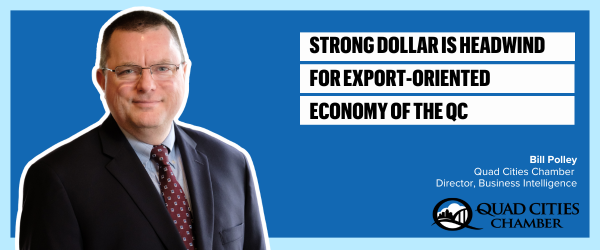
One additional piece of data that connects financial markets to the Quad Cities economy is the value of the dollar. The dollar remains strong, helped by higher interest rates. While the U.S. economy can sustain strong growth even with long-term rates above 4%, robust growth with higher rates will keep the dollar strong which is a headwind for the Quad Cities’ export-oriented economy. Thus, while growth is possible with higher long-term rates, lower long-term rates would be more beneficial to the Quad Cities.
Next week: 4th quarter U.S. GDP