





Source: Bureau of Economic Analysis, Bureau of Labor Statistics
Weekly Economic Trends and Indicators
November 26, 2024
The Headline:
According to the Bureau of Labor Statistics (BLS), the Consumer Price Index for All Urban Consumers (CPI-U) rose 0.2% in October (seasonally adjusted). The CPI inflation rate for the last 12 months was 2.6% (seasonally unadjusted). Excluding the more volatile components of food and energy (often referred to as “core inflation”), the index rose 0.3% in October and 3.3% over the last 12 months.
The Details:
The chart below shows different measures of inflation over the last few years. The Federal Reserve’s preferred measure is the Personal Consumption Expenditures (PCE) Price Index (blue). Most people are more familiar with the CPI (red) and the core CPI (yellow). The CPI for the Midwest (green) is also shown for reference.
The Context:
For most of the last 20 years, core CPI has remained mostly within a narrow range of 2.0 to 2.5%. Prior to the global financial crisis, core CPI was generally below the overall CPI, reflecting significant upward pressure on inflation from energy prices due to increasing global demand. However, by 2012, that had reversed. Energy prices have fluctuated significantly since then, mostly trending lower until 2016, but core inflation was remarkably consistent. After COVID, headline inflation reached the highest level in decades at nearly 9%, but core peaked just above 6% as it was food and energy prices that caused the largest contribution to inflation.
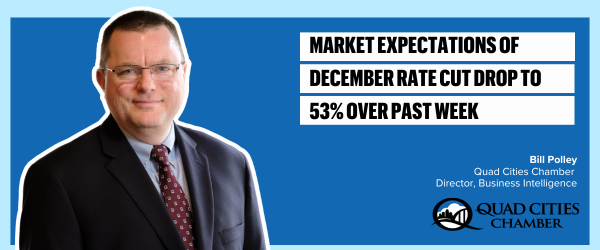
Today, core inflation exceeds the headline number, as it did before COVID. The improvement of overall inflation toward the Fed’s 2% goal is largely due to the fall in energy prices, which are down nearly 5% over the last 12 months. Meanwhile, the prices of shelter, transportation services, and medical care services are still rising at high rates. Overall service price inflation has been 4.8% over the past 12 months. This is why the Fed remains concerned about inflation even as so much progress has been made. These concerns have driven the 10-year Treasury yield up nearly 80 basis points since mid-September. Mortgage rates have followed suit. As of November 22nd, The market expectations of a December rate cut have also dropped to just 53% down from 62% a week ago.
Next week: Energy prices
Recent trends in inflation

Contact
Bill Polley
Senior Director, Business Intelligence - Grow Quad Cities
Click to View Email