



Weekly Economic Trends and Indicators

The Headlines:
The Federal Reserve recently reported that industrial production (IP) decreased by 0.3% in September. The decline was mostly due to the strike at Boeing and the effect of two hurricanes affecting the southeastern U.S. during the month. Over the last year, IP has decreased by 0.6%, but since April, IP has increased by about 0.2%.
According to the same report, capacity utilization decreased from 77.8% to 77.5%, which is about 2.2% below its long-run (1972-2023) average.
The Details:
Looking specifically at the manufacturing component of IP and capacity utilization, we find that manufacturing IP has decreased by 0.5% over the last year with declines in four of the last six months. Durable good manufacturers have seen the largest declines, with computers and electrical equipment being the only subcategories of durables that have increased production this year. Nondurable manufacturing IP has increased by 0.5% with printing experiencing the largest increase (6.7%) followed by petroleum, coal, and chemicals.
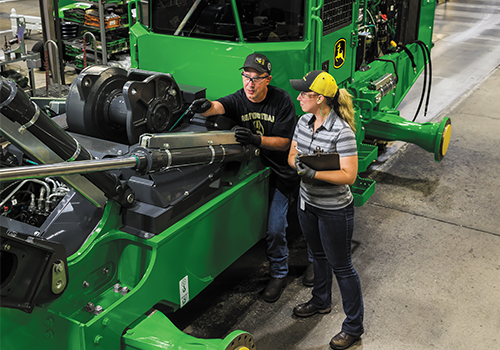
While manufacturing capacity utilization remains below its 1973-2023 average, it is roughly on par with the post-2000 non-recessionary average. Machinery manufacturing (which is well-represented in the Quad Cities) capacity utilization is above its long-run average, currently sitting at 80.5%. In general, manufacturing capacity utilization has been mostly stable after bouncing back from the COVID-19 recession.
The Context:
We have been tracking the slow but steady decline in manufacturing output and employment since it began to show up in the data. This decline has been responsible for at least part of the recession concerns over the last couple of years. Certainly, higher interest rates have been partly to blame, however it is also likely that the quick bounce-back after the COVID-19 recession led to some overproduction which is now being corrected. There are other cyclical factors in specific industries (such as agriculture) which are also at work.
In the Quad Cities, while manufacturing employment is about 5% down from its 2022 peak, manufacturing’s share of total employment is essentially unchanged from the peak, holding at 14% of employment, which is up from 13.2% before the 2008 financial crisis.
How can we interpret this? Manufacturing has been under pressure for the last year both regionally and nationally. However, the contraction we have seen locally is a mix of sector-specific factors and demographic changes to the labor force rather than a large and widespread drop in demand. There is robust competition for workers equipped for an advanced manufacturing world. As long as the U.S. economy can continue to avoid recession, lower interest rates should help manufacturing employment stabilize over the couple of years.
Next week: 3rd Quarter U.S. GDP