


State legislators discuss how they are supporting businesses throughout region
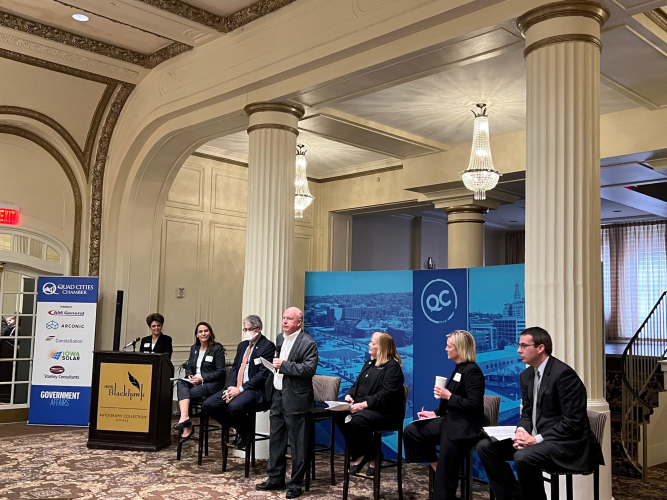
During the kickoff of the Chamber’s 2022 Legislative Event Series on Feb. 11, six state policymakers from Illinois and Iowa discussed the work they continue to do to support the challenges and opportunities important to businesses throughout the region.
Iowa Sen. Chris Cournoyer, Iowa Sen. Jim Lykam, Iowa Sen. Roby Smith, Illinois Rep. Mike Halpin, Iowa Rep. Monica Kurth and Illinois Rep. Tony McCombie each spoke on issues identified within the Chamber’s 2022 Regional Advocacy Priorities, a platform we will work to advance with lawmakers throughout the legislative sessions. The four priorities are: talent attraction and development, placemaking, fostering a business-friendly environment, and economic recovery from COVID-19. (Iowa Rep. Cindy Winckler accepted an invitation to participate; however, due to last-minute car trouble she was unable to attend).
The event was supported by our annual sponsors AM General LLC, Arconic, Constellation – Quad Cities Nuclear (formerly Exelon), Iowa Solar, Stanley Consultants and our location sponsor Hotel Blackhawk.
Each question is followed by an answer provided by at least one panel participant.
Q: One of the main concerns for business is finding qualified workers. How are you or your caucus addressing building a workforce and a talent pipeline?
A: Illinois Rep. Mike Halpin: “Illinois has one of the most skilled workforces in the country and part of that is because we are willing to invest in worker safety, invest in the minimum wage, and invest in workforce development training programs for persons who find themselves out of work or in transition to a new job. We continue to do that, and we are going to see wages go up in the State of Illinois next year. We continue to invest in workers. If you have a choice between a job paying $17 an hour and something only paying $12 an hour, that is a significant increase. We are committed to helping our businesses maintain our small business credits with regards to the minimum wage to make sure it is not a burden on small businesses.”
Q: Businesses are not only impacted by the workforce shortage but also the rising cost of unemployment insurance. How do you propose to address rising unemployment insurance costs going forward?
A: Iowa Sen. Chris Cournoyer: “Gov. Reynolds in Iowa put money into unemployment trust fund using federal American Rescue and Recovery Act money and she also proposed in her State of the Union address reducing unemployment from six months to four months. We have way more jobs than people in the State of Iowa. We know good jobs are out there, so the governor is proposing we reduce that timeframe and increase the number of searches required so people can get back into the workforce in a timelier manner. I think that will do a lot to help with those unemployment costs and get people back to work. We know a lot of businesses out there have to be closed on Monday because they don’t have a workforce. Hopefully limiting the number of months people have to look for those jobs will incentivize them to get back into the workforce.”
Q: Early childhood education is a workforce issue. Our members tell us that accessible, qualified, and affordable early childhood education is a major issue for them. What are some of the ideas and legislation being proposed to address these problems?
A: Iowa Rep. Monica Kurth: “There is a bill being considered for funding early childhood education that would increase the number of spots available, increase early education from half a day to full day, which is important for children who do not have a parent or caretaker available to take them or pick them up from school. What we’ve found is every dollar we put into early childhood education pays us big benefits as these children go through education programs later.”
Q: What are some new ways to support the business ecosystems in our downtowns and business corridors as remote working becomes a greater part of our workforce?
A: Iowa Sen. Jim Lykam: “The current district I represent includes the downtown and I really like what Davenport has been doing with its flood mitigation. I remember standing only a couple blocks up at 3rd Street and Perry when the dike broke a few years back and we’re getting some downtown development that needs to withstand this type of flood without obscuring the view of the Mississippi River, which is a great asset for us. I remember having conversations with Mayor Mike Matson and the council about how they are going along with this and I want to keep those conversations going as we’re moving forward with this issue.”
A: Illinois Rep. Mike Halpin: “As far as downtown business revitalization, I’ve been a longtime supporter of historic tax credits that were passed in the State of Illinois I believe in 2015 and increasing current state-wide cap for current businesses eligible for those tax credits. I also am committed to providing state grants to our downtowns. I know the City of Rock Island is currently seeking one of those grants for the great work it is trying to do down in the district. I continue to work on those issues with the Department of Commerce and Economic Opportunity to bring those grants to this area to make sure our riverfront and downtowns have that same access to opportunity that other places in the suburbs and Chicago do.”
Q: It was reported this week the State of Illinois ranks as one of the fastest-growing states for new businesses opening. What do you attribute this to and how do you plan to promote Illinois as a business-friendly state?
A: Illinois Rep. Tony McCombie: “Illinois has so much potential to be one of the best states in the Midwest. We have so many natural resources, so much ability, but in Springfield and unfortunately in DC, we write policy that makes it very difficult for us to grow. There has to be some government but making government so large regardless of the state does not benefit businesses. We need to get out of the business of regulating your businesses so much. There are a lot of things we could do to help whether it is workers' compensation, unemployment, or infrastructure, which we are working on in Illinois certainly, but that will always be an issue. We can’t all of a sudden begin working on infrastructure because it's already broken down. It has to be continuous.”
Q: The Iowa Senate is working on an ambitious tax reform bill that includes substantial reductions in both the corporate and individual income rates. While we are inclined to be supportive of a reduction in the corporate rates, how do you propose this reform, or any tax reform bill, account for lost revenue?
A: Iowa Sen. Roby Smith: “Iowa is on the forefront of this. Yes, we are looking to return money back to the hardworking taxpayers of Iowa. We have a $1 billion surplus, $2 billion in the Taxpayer Trust Fund which was created to be returned to taxpayers in Iowa. That is how we can pay for it. We have it in our five-year budget, and we can still pay for the tax cuts from the lost revenues from what we have in reserves; plus, we have economic growth overall, so we can fund education like we have, healthcare like we have, and public safety like we have and I’m confident we will do that.”