


Resilience of national economy could help QC economy in 2025
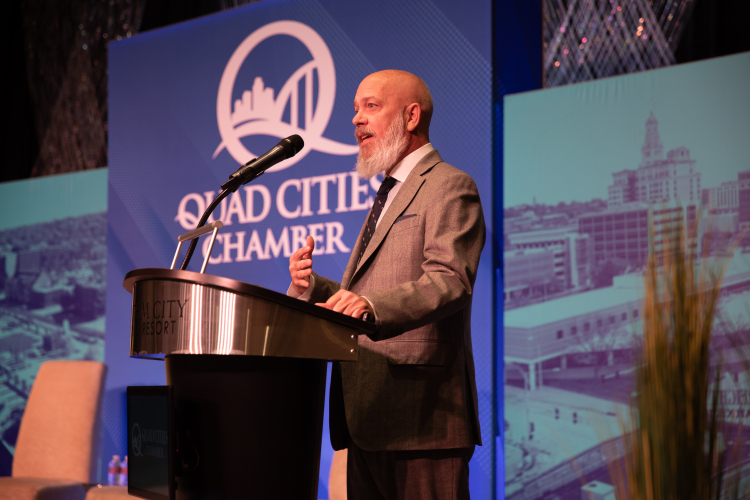
At the Chamber’s annual Economic Forecast meeting, expert economists Kevin Depew, RSM Deputy Chief Economist, and Bill Polley, the Quad Cities Chamber’s Director of Business Intelligence, provided an in-depth national, regional and local economic analysis.
“The U.S. growth outlook shows us that we’ve experienced the best economy in a generation – that people still love to hate.”
Depew’s presentation focused on the continued resilience of the economy including a look back at trends from the early 2000s, current GDP growth and the Fed’s recent rate cuts – with an update on potential risks.
“Now we’re in a new economic environment that’s supportive of higher interest rates, supportive of higher wages – and GDP well above the trend growth rate at 2%,” said Depew.
A number of factors could impact our current situation:
What could go wrong?
Negatives:
- Reaccelerating inflation could lead to a more hawkish Fed policy.
- Geopolitical tensions, such as rising oil prices, could add pressure to global markets.
- Corporate debt and commercial real estate face looming maturity challenges, potentially impacting small and regional banks.
- Persistent trade wars and tariff policies add to the uncertainty for businesses.
What could go right?
Positives:
- Price stability could encourage renewed investment.
- Fiscal stimulus through tax cuts and reduced regulations could spur economic activity.
- Strong consumer spending might persist, supporting growth.
- Acceleration in capital expenditure (capex) and productivity gains could offset risks, mirroring trends from 2009–2019.
When it comes to the Quad Cities economy, Bill Polley said, “GDP in the 6-county Chamber service area grew at a rate of 1.3% in 2023 after adjusting for inflation.” He added that agricultural production, manufacturing and wholesale trade weighed negatively on GDP in the region while retail trade and professional and business services contributed positively.
“So far in 2024, net job growth has been negative, with professional and business services and manufacturing experiencing significant declines,” Polley said. Due to the job losses, GDP growth in the Quad Cities area is expected to be lower in 2024.
On a positive note, Polley emphasized that the continued resiliency of the national economy is a strong factor in how the Quad Cities will fare in 2025. “Due to a strong national economy, the Quad Cities region could experience some improvement in the next year as the labor market stabilizes and interest rates continue to decrease,” he said.