





Illinois Funnel deadline extended; Chamber tracking priority legislation
The Chamber has been actively advocating on behalf of the local business community, monitoring various bills with significant impact. The committee deadline in Illinois was set for Friday, March 21, but the Senate has since extended that deadline to Friday, April 11.
Priority Legislation
The Chamber’s priority legislation did not move through Senate committee last week, but remains eligible for a vote following a rule 2-10 change that extends the deadline as stated above.
Middle Income Housing Incentive - SB1926/1927
The Chamber remains committed to moving legislation that will provide parity for new housing development and redevelopment in the Illinois Quad Cities. This bill would create a new incentive that allows municipalities to directly compete for funds to subsidize the creation of new market-rate units rented at or below 140% of area median income. The legislation specifically prohibits income restrictions on these units, meaning that renters and developers will not have to undergo cumbersome income certification, and renters will not be forced out of their units when their income grows.
Brownfield/Grayfield Enhancement - SB1178
The Chamber has continued to pursue legislation that will further incentivize the redevelopment of blighted parcels that are either contaminated or vacant, creating additional incentive to invest in Illinois communities.
Passenger Rail
Various bills have been introduced impacting the future of passenger rail in the Quad Cities, including legislation related to the future solvency of Chicago transit organizations, which could be an opportunity to provide new funding for the Moline – Chicago connection. These will continue to be top priorities for the Quad Cities Chamber through the remainder of the session. Notably, issues relating to Chicago transit agencies must be addressed before adjournment this spring to head off the possible fiscal cliff.
Site Readiness
The Chamber also remains committed to growing investment in site readiness across Illinois. Gov. Pritzker announced in his annual address that he would be proposing a $500 million dollar investment in site readiness, including $300 million for redevelopment of state-owned sites, and an additional $200 million for additional sites across the state. This language has not been introduced, but will likely be a part of a larger budget package near the end of the legislative year.
Additional bills impacted by the passage deadline:
NOTE: Because the Senate extended their deadline to Friday, April 11, only house bills will be listed below.
Bills that passed:
- HB3604 (Support): Repeals the moratorium on new nuclear capacity.
- HB3091 (Support): Establishes a new program to support regional manufacturing partnerships.
- HB2982 (Opposed): Eliminates the Tipped Wage Credit.
- HB3266 (Opposed): Mandates all projects in a TIF District funded, in whole or in part by public funds, to be considered public works unless the project cost is under $25,000.
- HB3774 (Opposed): Amends the Illinois Wage Payment and Collections Act to increase enforcement measures.
Bills that did not pass:
- HB3100 (Support): Lowering matching requirements for convention and tourism bureaus.
- HB1602 (Support): Permanent extension of the R&D tax credit.
- HB2991 (Support): Advance allocation of grant funds for CVBs.
- HB1142 (Opposed): Requiring referendum for TIF Districts.
- HB1400 (Opposed): Setting Daylight Savings Time as the permanent time for Illinois.
- HB2946 (Opposed): Creating a new mandate to provide paid family medical leave with a new tax/fee on businesses to administer the program.
Illinois Chamber Day
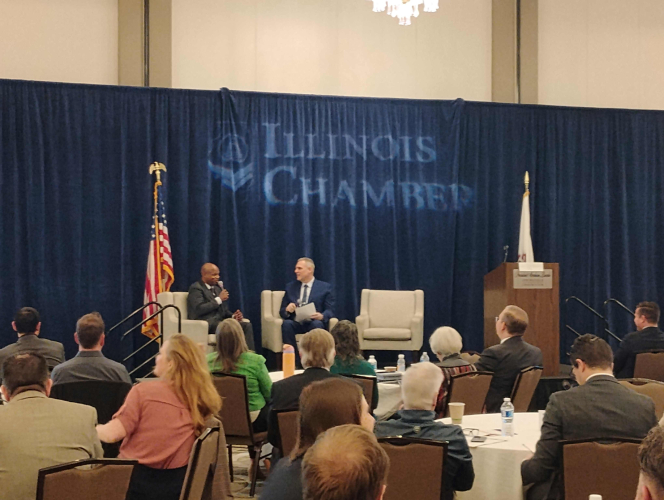
In conjunction with the House committee deadline, the Quad Cities Chamber attended the 2025 Illinois Chamber of Commerce Day in Springfield. Staff engaged with leaders from the Illinois House and Senate, including the Speaker, Majority Leader and Minority Leaders and discussed the legislative session's progress and its impact on Illinois businesses.
The event offered crucial insights into business-related legislation from state elected officials, as well as valuable networking opportunities with downstate Illinois Chambers. Illinois Chamber staff provided comprehensive updates on relevant bills, offering important context for our tracking efforts and a broader understanding of issues facing Illinois communities. Despite the continued presence of anti-business legislation, we were encouraged by the bipartisan commitment from state officials to consider business perspectives in policymaking. Moving forward, the Chamber will continue to pursue networking and educational opportunities to strengthen advocacy for a healthy business environment in Illinois and our region.