


Education-industry partnership helps fill skills gap

Manufacturing companies looking to fill the skills gap are turning to Quad Cities region high schools for the next generation of workers.
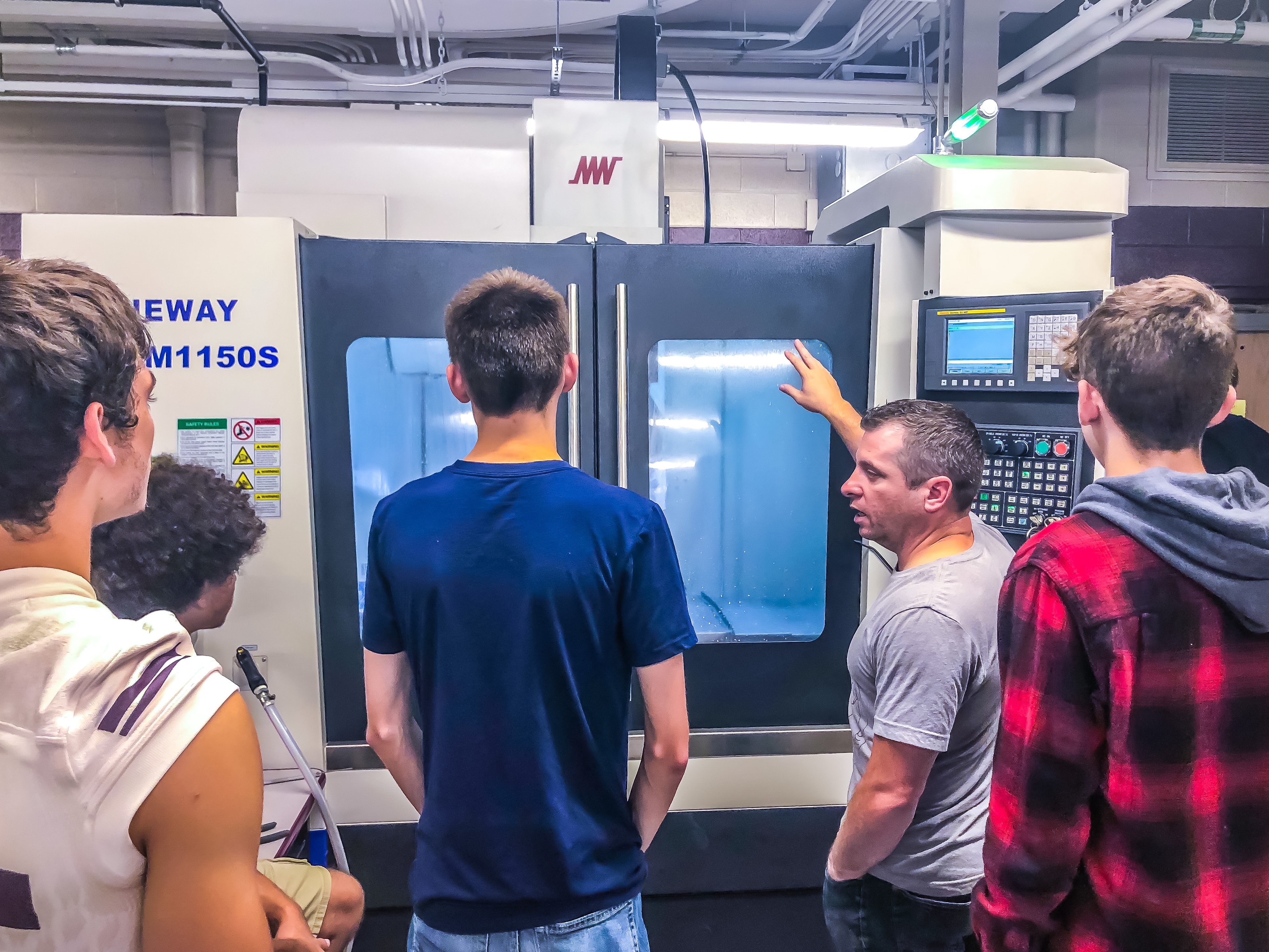
Moline High School is the first in the Illinois Quad Cities to launch a CNC machining apprenticeship program affiliated with Black Hawk College and registered with the U.S. Department of Labor. Starting in high school, students take on internships with local CNC manufacturers and later complete classes at Black Hawk to earn a journeyman's certification. This is but one example of how educational partners are collaborating with industry in the region to meet workforce needs.
“The ultimate goal is to get these kids trained and employed,” Moline High School Principal Trista Sanders said during the Quad Cities Chamber’s recent tour of the school's machine shop with representatives from area manufacturing companies. “This is a program that will keep kids invested in school and give them a career path afterward.”
The program’s advisory board includes representatives from the Chamber's Quad Cities Manufacturing Innovation Hub and area manufacturers Bowe Machine, P&R Manufacturing, RILCO, John Deere Seeding Group and Evans Manufacturing.
Rebuilding the talent pipeline
With 13 to 14 agreed-upon apprenticeship sites and 21 Moline juniors seeking apprenticeships, Sanders said there still are opportunities available for manufacturing employers to host students.
“We didn't know where this was going, but the experience has been spectacular,” David Ottavianelli, Deere & Co.'s Director of Labor Relations, said. He sits on the advisory board and shared Deere recently invited high school students to participate in six welding apprenticeships. “The students have a mantra: 'If you're not 10 minutes early, you're late.' Their technical skills have been impressive. It's a great opportunity to build on that pipeline of talent.”
There are similar programs at Davenport's public high schools, North Scott High School in Eldridge and Clinton (Iowa) High School. Ottavianelli said Rock Island High School also is working on a similar apprenticeship program.
Industrial arts saw a decline across high school systems around the turn of the century. Sanders said in the post-World War II era Moline High School had a robust program with 16 teachers and 11 classrooms dedicated to school-to-career building with equipment donated from the Rock Island Arsenal and elsewhere.
The federal No Child Left Behind (NCLB) program in the early 2000s crippled elective programs across the country for the sake of concentrating on basic reading and math skills, she said. Moline High School's program was reduced to “bare bones” with two teachers after NCLB.
The decline is one of the contributing factors to the lack of qualified tradesmen today. Brandon Buster of Lee Agency, a Muscatine-based insurance agency that represents multiple manufacturers, said the biggest challenge his clients face is finding new talent.
“Retiring are highly skilled trades people with 30, 40 years of experience,” Buster said. “We need to get the young people in and learn from these people.”
Trades industry perks
Availability of workforce continues to be an issue for area employers, both in availability of labor in the community to fill open jobs and the number of graduates coming through the educational pipeline.
Of the companies interviewed in 2019 as part of the Quad Cities Chamber's Business Connections program, 62% are experiencing recruitment issues. Of that number, 48% are experiencing skilled labor shortages, including CNC operators, CDL drivers and tool and die makers.
Aric Halloran, factory manager of John Deere Cylinder in Moline, said the demand for students in technical professions is an “eye opener.”
“For a long time we heard no one wanted to work in manufacturing,” Halloran said. “But there is a lot of interest. We need to get them the vehicle to get jobs.”
Buster believes if teenagers are made aware of the perks of the trades industry, including competitive pay scale and job availability, more would pursue that over increasingly expensive four-year college degrees.
“You get in on the ground level, and if you like the industry, there are tons of paths available,” Buster said.
Emily Wyldes with DES Employment Group, an employment agency that represents more than 20 regional manufacturing and industrial warehouse companies, said Moline's apprenticeship program is one way to fill the high demand-low supply employee gap.
“This program is a great way to get students the skills they need,” she said. “When they're done there will be a whole bunch of job opportunities available to them.”
James Lay, a representative of Arconic who attended the recent tour, was impressed with what he was hearing about Moline's apprenticeship program.
“Any kind of skills a new hire can bring with them will be advantageous,” he said. “We should find other resources outside our plant walls to get skilled people.”
‘Chase after your dream’
Moline High School students aspiring to a career in the trades met face to face with industry leaders during the tour on their home turf.
Senior Seth Stubblefield wants to parlay military service into a career.
“If I go into the military, it might help me get into the trades easier,” Stubblefield said. “The (U.S.) Navy will give me work experience.”
Marcus Needham, labor relations manager at John Deere Davenport Works, emerged from the crowd to address students.
“It's important to find a path and stick with it,” Needham said. “All of us have a different path in life. Find it. Be passionate about it. Chase after your dream.”
The Quad Cities Manufacturing Innovation Hub, a division of the Chamber's Economic Development department, works with area manufacturers and other companies throughout the defense supply chain to help them grow, diversify and remain competitive.